History · Ch 7 — Paths to Modernisation
Establishing the Republic
Establishing the Republic
The republic was not born out of a sudden revolution but out of a long-building crisis. By 1911 the Manchu empire had collapsed, and in its place stood a republic under the leadership of Sun Yat-sen, the man history remembers as the founder of modern China. The story of this founding is really the story of one man's ideas meeting a country in chaos.
Sun Yat-sen (1866–1925) came from a poor family, and his early education took place in missionary schools. It was there that he was first introduced to two things that would shape his entire political vision: democracy and Christianity. He trained as a doctor, but his real concern was not the health of individual patients — it was the fate of China itself. He saw a country humiliated by foreign powers and ruled by a dynasty he considered alien, and he turned from medicine to politics.
His political programme rested on what he called the Three Principles (San min chui). These were not vague slogans but a concrete plan for rebuilding China:
- Nationalism — this meant overthrowing the Manchu, who were seen as a foreign dynasty, and also driving out the other foreign imperialists who had carved up Chinese territory and privilege.
- Democracy — establishing a democratic government to replace the autocratic imperial system.
- Socialism — regulating capital and equalising landholdings, so that wealth and land did not remain concentrated in the hands of a few.
The Three Principles were thus a single package: political freedom, national independence, and economic justice. Each one answered a specific failure of the old order — foreign domination, authoritarian rule, and gross inequality. …
Shanghai in 1935: Buck Clayton, a black American trumpet player, in Shanghai with his jazz orchestra lived the life of the privileged expatriates. But he was black and once some white Americans assaulted him and his orchestra members and threw them out from the hotel they played in. Thus, though American, he had greater sympathy for the plight of the Chinese being himself a victim of racial discrimination. Of their fight with white Americans where they emerged victorious he writes, 'The Chinese onlookers treated us like we had done something they always wanted to do and followed us all the way home cheering us like a winning football team.'
On the poverty and hard life of the Chinese, Clayton writes, 'I would see sometimes twenty or thirty coolies pulling a big heavy cart that in America would be pulled by a truck or horses. These people seemed to be nothing but human horses and all they would get at the end of the day was just enough to get a couple of bowls of rice and a place to sleep. I don't know how they did it.' …
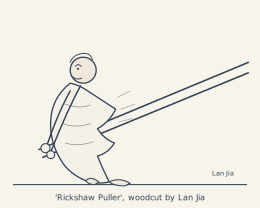
Drawn by us to help you understand the concept clearly, and verified to make sure it's accurate. For exams, practice from your NCERT textbook's own diagram.
The woodcut shows a single, unnamed rickshaw-puller caught mid-stride, his body pitched forward and braced against the long shafts of his vehicle. There is no background scenery, no street, no crowd — the composition isolates the man and his rickshaw entirely, forcing the eye onto the physical strain of the pull. His posture is the whole story: legs driving, back bent, arms locked onto the shafts, the rickshaw itself tilting behind him as if it carries a weight we cannot see. The medium of woodcut suits the subject — bold, dark lines and stark contrasts give the labour a rough, gritty texture, the opposite of a polished portrait.
What the image teaches is the human cost of modernisation. The chapter's narrative of China's republic is built around Sun Yat-sen's grand ideas — nationalism, democracy, socialism — but this figure shows the ordinary worker on whose back that new nation was being hauled forward. The rickshaw-puller was a symbol of urban poverty in early twentieth-century China, a man reduced to a beast of burden, and Lan Jia's woodcut captures that reduction without sentimentality. The title itself, Rickshaw Puller, is a class label as much as a job description. …
An illustrated strip prints seven everyday items, each set against the year in which a fixed sum of money bought only that much:
| Year | What the same money bought |
|---|---|
| 1937 | Oxen |
| 1939 | A pig |
| 1941 | A sack of flour |
| 1943 | A hen |
| 1945 | Eggs |
| 1947 | A piece of coal |
| 1949 | A sheet of paper |