History · Ch 7 — Paths to Modernisation
Industrial Workers
Industrial Workers
The story of China’s modernisation does not end with economic policy. By the late 1970s, a deeper question had surfaced: could China modernise without political freedom? The answer to that question would shape the country’s trajectory for decades, and it is here that the textbook turns from factories and farms to the struggle over democracy itself.
In December 1978, a wall-poster appeared in Beijing titled ‘The Fifth Modernisation’. The four modernisations — in agriculture, industry, defence, and science and technology — had been the official programme of the state. This poster argued that a fifth modernisation, democracy, was the foundation without which the other four would come to nothing. It went further, criticising the Chinese Communist Party (CCP) for failing to solve the problem of poverty and for not ending sexual exploitation. It even cited cases of such abuse from within the Party itself.
These demands were suppressed. But the issue did not die. In 1989, on the seventieth anniversary of the May Fourth movement — the great intellectual and cultural movement of 1919 that had called for science and democracy — many intellectuals again called for greater openness and an end to what they termed ‘ossified dogmas’. The phrase, attributed to Su Shaozhi, captured the sense that the Party’s ideology had become rigid and lifeless.
That same year, student demonstrators gathered at Tiananmen Square in Beijing. They were brutally repressed. The crackdown was strongly condemned around the world.
The post-reform period has since seen the emergence of sustained debates on how China should develop. Two broad positions have crystallised.
The dominant view, supported by the Party, rests on three pillars:
- strong political control
- economic liberalisation
- integration into the world market
Critics challenge this model on several grounds. They point to increasing inequalities — between social groups, between regions, and between men and women — and argue that these are creating social tensions. They also question the heavy emphasis placed on the market as the solution to every problem.
Finally, there is a growing revival of earlier, so-called ‘traditional’ ideas. Confucianism, long attacked during the Cultural Revolution, has made a comeback. The argument now is that China can build a modern society by following its own traditions rather than simply copying the West.
The fifth modernisation …
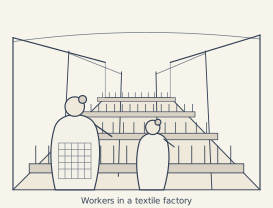
Drawn by us to help you understand the concept clearly, and verified to make sure it's accurate. For exams, practice from your NCERT textbook's own diagram.
The photograph shows a Japanese textile mill in the late nineteenth century, with row after row of spinning machinery receding into the distance. The workers are all women, dressed in simple work clothes, standing at their machines or moving between the aisles. The sheer scale of the hall — the machinery stretching far back, the repetitive layout — makes clear this is a modern factory, not a craft workshop.
The image is a quiet but powerful comment on how industrialisation actually happened in Japan. The Meiji state pushed modernisation from above, building factories and importing technology, but the hands that ran those machines were overwhelmingly female. Over half of Japan's modern-factory workforce was female well into the twentieth century. Young women, often from poor rural families, were recruited to work long hours in textile mills for low wages, living in company dormitories under strict supervision.
What makes the figure significant for the chapter is that it complicates the story of modernisation as a purely technological or political achievement. The same factories that symbolised Japan's rapid industrial rise also created new forms of exploitation. And the women were not passive victims — they organised Japan's first modern strike in 1886, demanding better conditions. The photograph therefore captures both the engine of Japan's economic transformation and the social cost that transformation carried, a cost borne disproportionately by women. …