History · Ch 7 — Paths to Modernisation
The Meiji Restoration
The Meiji Restoration
The Meiji Restoration
The Meiji Restoration was not a sudden event. It grew out of a combination of internal discontent within Japan and external pressure from Western powers demanding trade. When Commodore Matthew Perry of the United States arrived in 1853, he demanded that Japan sign a treaty permitting trade and opening diplomatic relations. Japan agreed the following year. The Americans wanted access to Japan partly because it lay on the route to China, which they saw as a major market, and partly because their whaling ships in the Pacific needed a place to refuel. At that time, Holland was the only Western country trading with Japan.
Perry's arrival transformed Japanese politics. The emperor, who had until then possessed little political power, re-emerged as a significant figure. In 1868, a movement forcibly removed the shogun from power and brought the emperor to Edo. This city was made the capital and renamed Tokyo, meaning 'eastern capital'.
The Silk Economy and Rising Entrepreneurs
The Nishijin quarter in Kyoto illustrates how economic change prepared the ground for political transformation. In the sixteenth century, it had a weavers' guild of 31 households. By the end of the seventeenth century, the community had grown to over 70,000 people. Sericulture spread and was encouraged by an order in 1713 that only domestic yarn was to be used. Nishijin specialised only in the most expensive products.
Silk production helped grow a class of regional entrepreneurs who challenged the Tokugawa order. When foreign trade started in 1859, Japan's silk exports became a major source of profit for an economy struggling to compete with Western goods.
Fear of Colonisation and the Response
Officials and ordinary people were aware that European countries were building colonial empires in India and elsewhere. News of China's defeat by the British was flowing in and was even depicted in popular plays. There was a real fear that Japan might be made a colony.
Different responses emerged among scholars and leaders. Some wanted to learn from the new ideas in Europe rather than ignore them as the Chinese were doing. Others sought to exclude the Europeans while still being ready to adopt the new technologies they offered. Some argued for a gradual and limited 'opening' to the outer world.
The government launched a policy with the slogan 'fukoku kyohei' (rich country, strong army). They realised they needed to develop their economy and build a strong army, otherwise they would face subjugation like India. To achieve this, they needed to create a sense of nationhood among the people and transform subjects into citizens.
The Emperor System
The new government also worked to build what they called the 'emperor system'. Japanese scholars use this term because the emperor was part of a system, along with the bureaucracy and the military, that exercised power. Officials were sent to study the European monarchies on which they planned to model their own.
The emperor was treated with reverence as he was considered a direct descendant of the Sun Goddess, but he was also shown as the leader of westernisation. His birthday became a national holiday, he wore Western-style military uniforms, and edicts were issued in his name to set up modern institutions. The Imperial Rescript on Education of 1890 urged people to pursue learning, advance public good and promote common interests.
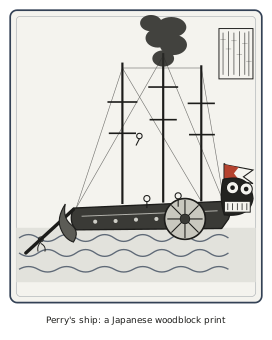
The Japanese called Perry's ships 'black ships' because tar was used to seal the joints of the wood. These ships are depicted in paintings and cartoons showing the strange foreigners and their habits. This became a powerful symbol of Japan's 'opening'.
Drawn by us to help you understand the concept clearly, and verified to make sure it's accurate. For exams, practice from your NCERT textbook's own diagram.
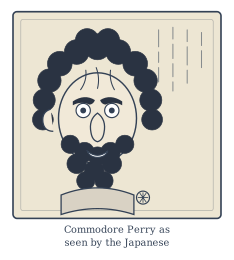
The print is a Japanese woodblock caricature of Commodore Matthew Perry, the American naval officer who arrived in Japan in 1853. The Japanese artist has drawn Perry as an oversized, grotesque figure — a common technique in Japanese satire of the time, used to mock the strange and threatening foreigner. The image exaggerates his features, making him appear large, foreign, and slightly ridiculous, which captures the mixture of fear, curiosity, and contempt with which many Japanese initially viewed the Americans.
The ship itself is the key visual element. Perry arrived on a steam-powered warship, one of the famous "black ships" — so called because the hulls were sealed with tar, which gave them a dark colour. The woodblock print shows this vessel, and the artist has taken care to render its unfamiliar technology: the paddle wheels, the smokestack, and the dark, hulking hull. To a Japanese audience in the 1850s, these ships were astonishing — they moved without sails, belched smoke, and carried guns that could destroy coastal defences. The print thus records not just a person but a technological shock, the visible symbol of Western industrial power that Japan could no longer ignore.
The composition of the print typically places Perry and his ship together, with the ship looming in the background or beside him, so that the viewer reads the two as one unit: the man and the machine that made him powerful. The artist's caricature of Perry's face — often shown with a large nose, heavy brow, and stern expression — plays on Japanese stereotypes of Westerners. The exaggerated features were meant to be humorous, but the humour carried an edge of anxiety. This is not a neutral portrait; it is a political cartoon, a visual commentary on the arrival of a force that would overturn two centuries of Japanese policy. …
Today, scholars would argue that Japan had not actually been 'closed' — it took part in east Asian trade and had access to knowledge of the wider world both through the Dutch and the Chinese.
The New School System
A new school system began to be built from the 1870s. Schooling was compulsory for boys and girls, and by 1910 it was almost universal. Tuition fees were minimal. The curriculum was based on Western models, but by the 1870s, while emphasising modern ideas, stress was placed on loyalty and the study of Japanese history.
The ministry of education exercised control over the curriculum, the selection of textbooks, and teachers' training. What was called 'moral culture' had to be taught, and texts urged children to revere their parents, be loyal to the nation, and become good citizens.
Language and Script
The Japanese had borrowed their written script from the Chinese in the sixth century. However, since their language is very different from Chinese, they developed two phonetic alphabets — hiragana and katakana. Hiragana is considered feminine because it was used by many women writers in the Heian period, such as Murasaki. Japanese is written using a mixture of Chinese characters and phonetics: the main part of the word is written with a character, while grammatical endings are written phonetically. For instance, in 'going', 'go' would be written with a character and the 'ing' in phonetics.
The existence of a phonetic syllabary meant that knowledge spread from the elites to the wider society relatively quickly. In the 1880s, it was suggested that Japanese develop a completely phonetic script, or adopt a European language. Neither was done.
The Japanese had borrowed their written script from the Chinese in the sixth century. However, since their language is very different from Chinese they developed two phonetic alphabets – hiragana and katakana. Hiragana is considered feminine because it was used by many women writers in the Heian period (such as Murasaki). It is written using a mixture of Chinese characters and phonetics so that the main part of the word is written with a character – for instance, in 'going', 'go' would be written with a character and the 'ing' in phonetics.
The existence of a phonetic syllabary meant that knowledge spread from the elites to the wider society relatively quickly. In the 1880s it was suggested that Japanese develop a completely phonetic script, or adopt a European language. Neither was done. …
Administrative and Military Reforms
To integrate the nation, the Meiji government imposed a new administrative structure by altering old village and domain boundaries. The administrative unit had to have revenue adequate to maintain local schools and health facilities, as well as serve as a recruitment centre for the military.
All young men over twenty had to do a period of military service. A modern military force was developed. A legal system was set up to regulate the formation of political groups, control the holding of meetings, and impose strict censorship. In all these measures, the government faced opposition.
The military and the bureaucracy were put under the direct command of the emperor. This meant that even after a constitution was enacted, these two groups remained outside the control of the government. The tension between the ideals represented by a democratic constitution and a modern army was to have far-reaching consequences.
The army pressed for a vigorous foreign policy to acquire more territory. This led to wars with China and Russia, in both of which Japan was the victor. Popular demand for greater democracy was often in opposition to the government's aggressive policies. Japan developed economically and acquired a colonial empire that suppressed the spread of democracy at home and put it in collision with the people it colonised.
Modernising the Economy
Another important part of the Meiji reforms was the modernising of the economy. Funds were raised by levying an agricultural tax. Japan's first railway line, between Tokyo and the port of Yokohama, was built in 1870-72. Textile machinery was imported from Europe, and foreign technicians were employed to train workers, as well as to teach in universities and schools. Japanese students were sent abroad.
In 1872, modern banking institutions were launched. Companies like Mitsubishi and Sumitomo were helped through subsidies and tax benefits to become major shipbuilders, so that Japanese trade was from now on carried in Japanese ships. Zaibatsu — large business organisations controlled by individual families — dominated the economy till after the Second World War.
The population, 35 million in 1872, increased to 55 million in 1920. To reduce population pressure, the government actively encouraged migration, first to the northern island of Hokkaido, which had been a largely autonomous area where the indigenous people called the Ainu lived, and then to Hawaii and Brazil, as well as to the growing colonial empire of Japan. …
Drawn by us to help you understand the concept clearly, and verified to make sure it's accurate. For exams, practice from your NCERT textbook's own diagram.
The image is a Japanese woodblock print, a genre known as ukiyo-e, showing Commodore Matthew Perry as the Japanese public would have encountered him. Perry is drawn as a large, imposing figure, with exaggerated Western features — a prominent nose, heavy brows, and a stern expression — that mark him as unmistakably foreign. The caricature style is deliberate: it captures both the curiosity and the unease with which the Japanese viewed the arrival of the American fleet in 1853.
The print places Perry against the backdrop of his famous "black ships" — the steam-powered vessels that the Japanese called kurofune because their wooden hulls were sealed with black tar. These ships dominate the scene, their dark, hulking forms and smoking funnels contrasting sharply with the smaller Japanese boats around them. The contrast is the point: the black ships were not just vessels but symbols of Western industrial power, and the print visually registers the shock of that technological disparity. Perry himself is shown in his naval uniform, often with a sword at his side, reinforcing his role as a military envoy rather than a mere merchant.
The composition typically includes the bay and coastline, with the American squadron anchored offshore. Some versions of the print show Perry standing on a deck or a pier, facing the viewer directly, while Japanese figures — officials or commoners — are drawn smaller, sometimes peering at him from a distance or bowing. This spatial hierarchy is meaningful: it visually encodes the power imbalance that Perry's arrival created. The Japanese are not the agents of the scene; they are observers, reacting to an event that has been forced upon them. …