History · Ch 7 — Paths to Modernisation
Korean Democracy and the IMF Crisis
Korean Democracy and the IMF Crisis
Korean Democracy and the IMF Crisis
The story of Korean democracy after 1987 is one of slow, steady progress — from military rule to civilian presidents, through an economic crash, and finally to a democracy mature enough to remove a president through peaceful protest. The turning point was the new constitution, which allowed the first direct presidential election since 1971, held in December 1987.
That election, however, did not bring a civilian to power. The opposition parties failed to unite behind a single candidate, and so Roh Tae-woo — a fellow military leader from Chun Doo-hwan's faction — won. Yet the country did not slide back into authoritarianism. Democracy held, and in 1990 a significant political realignment took place: Kim Young-sam, a long-time opposition leader, compromised with Roh's party to create a large ruling party. This move paved the way for December 1992, when Kim Young-sam, a civilian, was elected president after decades of military rule. His election marked the dissolution of authoritarian military power and the forward march of democracy.
Economic growth and the road to crisis
Under the new administration, Korea continued its export-driven economic policy, which had already produced several companies of global prominence by the early 1990s. The government actively supported Korean conglomerates — the chaebols — in investing in capital-intensive heavy and chemical industries, as well as electronics. At the same time, the state kept building industrial and social infrastructure.
Then came the pressure to liberalise. Under increasing neoliberalist demands to open its market, the Kim administration joined the Organisation for Economic Cooperation and Development (OECD) in 1996, hoping to strengthen Korea's international competitiveness. But the economy was already fragile. Trade deficits were mounting, financial institutions were poorly managed, and conglomerates were running reckless business operations. In 1997, Korea was hit by a foreign currency crisis.
The crisis was handled through emergency financial support from the International Monetary Fund (IMF). Alongside this, the country worked to improve its economic constitution, and citizens actively contributed to repaying foreign loans through the Gold Collection Movement — a remarkable show of public solidarity.
The peaceful transfers of power
The crisis did not derail democracy. In December 1997, Kim Dae-jung, the long-time opposition party leader, was elected president — the first time in Korea's history that power passed peacefully from the ruling party to the opposition. This set a precedent.
The second peaceful transfer of power came in 2008, when conservative Lee Myung-bak was elected, following the progressive Roh Moo-hyun administration. In 2012, Park Geun-hye was elected as the first female president of Korea. At the start of her presidency, she drew support from the political legacy of her father, Park Chung-hee, the authoritarian leader who had driven Korea's industrialisation.
But in October 2016, it came to light that Park had allowed a friend to secretly manage government affairs. The revelation triggered nationwide protests — the famous candlelight protests — and led to her impeachment and removal from office in March 2017. In May 2017, Moon Jae-in was elected president, marking the third peaceful transfer of power.
What made Korean democracy mature …
Drawn by us to help you understand the concept clearly, and verified to make sure it's accurate. For exams, practice from your NCERT textbook's own diagram.
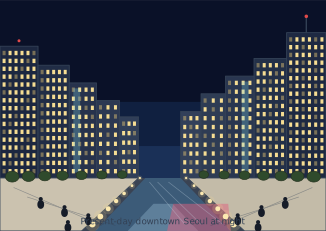
The photograph shows downtown Seoul after dark, and the first thing that catches the eye is the contrast between the natural and the built environment. A stream runs through the centre of the frame, its banks lined with trees that stand out against the surrounding concrete. Alongside this waterway rise modern high-rise buildings, their illuminated windows and facades turning the cityscape into a grid of light. The image is not a static monument or a heritage site — it is a living, working city at night, dense with the signs of continuous economic activity.
What makes this image significant for the chapter is what it represents rather than what it merely displays. The illuminated skyline and the well-maintained urban stream are physical evidence of decades of rapid industrialisation. South Korea's transformation from a war-torn, agrarian economy in the 1950s to a global industrial power by the 1990s did not happen in boardrooms alone — it reshaped the physical landscape. The high-rises speak to the growth of conglomerates and the export-driven policies that pushed Korean companies onto the world stage. The landscaped stream, meanwhile, reflects the later phase of development, when the focus shifted from sheer industrial output to building social and urban infrastructure that could support a modern, democratic society. …