History · Ch 7 — Paths to Modernisation
Continued Economic Growth and Calls for Democratisation
Continued Economic Growth and Calls for Democratisation
The story of South Korean democracy after Park Chung-hee is one of brutal suppression meeting rising public pressure, until the pressure became too great to contain. The key to understanding this period is that economic success did not pacify the people — it empowered them. Growth created an educated, urban, media-aware citizenry that began to see political rights as the natural next step.
Park’s death in 1979 did not bring democracy. In December of that year, another military coup took place, this time led by Chun Doo-hwan. The following May, students and citizens in major cities across the country protested, demanding democracy in the face of Chun’s military faction. The regime answered with martial law, imposed nationwide to crush the movement.
The city of Gwangju refused to back down. There, students and citizens held their ground and demanded an end to martial law, in what became known as the Gwangju Democratisation Movement. The military faction suppressed these protests too, and later that year Chun became president through an indirect election held under the Yusin Constitution — the very constitution Park had created to entrench his own rule. The Chun administration then tightened its suppression of democratic influences, all in the name of stabilising the regime.
Here is where the economic story enters. Partly because of a favourable international economic boom, the Chun administration oversaw a dramatic recovery: economic growth jumped from 1.7 per cent in 1980 to 13.2 per cent by 1983, while inflation fell significantly. But this development had social consequences the regime did not anticipate. Urbanisation spread, education levels rose, and the media advanced. Citizens became more self-aware about their political rights, and the demand crystallised into a specific goal: a constitutional amendment allowing the direct election of the president.
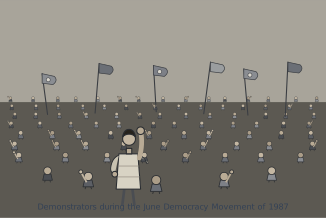
The breaking point came in May 1987. It became known that the Chun administration had minimised inquiries into the death-by-torture of a university student. The revelation triggered a large-scale struggle for democratisation. What followed was the June Democracy Movement, and its defining feature was its breadth — it was not just students this time, but the middle class as well.
Drawn by us to help you understand the concept clearly, and verified to make sure it's accurate. For exams, practice from your NCERT textbook's own diagram.
The photograph captures a street in Seoul during the June Democracy Movement of 1987. Demonstrators fill the frame, marching in a dense crowd with banners raised high above their heads. The banners carry slogans demanding democratisation and direct presidential elections — the central demand of the movement. The scene is one of mass participation: not just students, but middle-class citizens in ordinary clothing, reflecting the broad social coalition that the movement had built by June 1987.
The image teaches a crucial point about how the movement succeeded where earlier protests had failed. The Gwangju Democratisation Movement of 1980 was crushed by martial law, in part because it remained largely a student-and-citizen uprising in one city. By 1987, however, the Chun administration’s economic successes had created an urbanised, educated, media-aware middle class. That middle class now joined the students, and the sheer scale of the June demonstrations — visible in the packed streets of the photograph — made suppression politically and practically impossible. The banners are not just props; they are the visible expression of a unified demand that the regime could no longer ignore. …
…