History · Ch 7 — Paths to Modernisation
CHINA
CHINA
The central question of modern Chinese history was how to regain sovereignty, end the humiliation of foreign occupation, and achieve equality and development. Three broad groups offered competing answers. The early reformers, Kang Youwei (1858–1927) and Liang Qichao (1873–1929), tried to reinterpret traditional ideas in new ways to meet the Western challenge. Republican revolutionaries, inspired by Japan and the West, looked to overthrow the old order; Sun Yat-sen, the first president of the republic, belonged to this group. The third, the Communist Party of China (CCP), wanted to end age-old inequalities and drive out the foreigners.
China's first encounter with the West came in the sixteenth and seventeenth centuries, when Jesuit missionaries introduced Western sciences such as astronomy and mathematics. The immediate impact was limited, but it set in motion events that gathered force in the nineteenth century, when Britain used force to expand its lucrative opium trade, leading to the first Opium War (1839–42). This war undermined the ruling Qing dynasty and strengthened demands for reform.
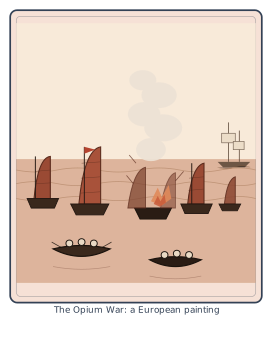
Drawn by us to help you understand the concept clearly, and verified to make sure it's accurate. For exams, practice from your NCERT textbook's own diagram.
The painting captures a single, violent moment in the First Opium War (1839–42): a naval clash at sea between Chinese junks and British warships. The composition is dominated by the confrontation of the two fleets, with one vessel already struck and burning. That burning ship is the visual anchor of the scene — it tells you this is not a formal portrait or a map, but an attempt to record the chaos and destruction of an actual battle.
What makes the image instructive is its perspective. It is a European painting, so the British ships are rendered with the technical detail of Western marine art — masts, rigging, and cannon fire drawn with care — while the Chinese junks appear as the enemy, shown in the act of engaging or retreating. The artist's eye is on the spectacle of combat, not on the politics behind it. The burning vessel, in particular, invites you to ask: whose ship is it, and what does the painter want you to feel about that?
The textbook places this image inside the section on China's struggle to regain sovereignty. The Opium War was the first major military humiliation inflicted by a Western power on the Qing dynasty, and it exposed how far China had fallen behind in military technology and organisation. The painting, precisely because it is a European work, embodies that asymmetry — it shows the war from the side of the victor, as a dramatic engagement, rather than from the side of the defeated, for whom it was a national catastrophe. The activity question that accompanies it — Does this painting give you a clear sense of the significance of the Opium War? — pushes you to notice what the image leaves out: the trade in opium, the destruction of the Chinese economy, the unequal treaties that followed. The painting gives you the smoke and fire of battle, but not the reasons for it. …
The Reformers and the Fear of Colonisation
Qing reformers like Kang Youwei and Liang Qichao realised the need to strengthen the system. They initiated policies to build a modern administrative system, a new army, and an educational system, and set up local assemblies to establish constitutional government. Their aim was to protect China from colonisation.
The negative example of colonised countries worked powerfully on Chinese thinkers. The partition of Poland in the eighteenth century was a much-discussed case — so much so that by the late 1890s it came to be used as a verb: 'to Poland us' (bolan wo). India was another such example. In 1903, Liang Qichao, who believed that only by making people aware that China was a nation would they be able to resist the West, wrote that India was 'a country that was destroyed by a non-country that is the East India Company'. He criticised Indians for being cruel to their own people and subservient to the British. Such arguments carried powerful appeal, as ordinary Chinese could see that the British used Indian soldiers in their wars on China.
The Opium Trade
The demand for Chinese goods such as tea, silk, and porcelain created a serious balance-of-trade problem. Western goods found no market in China, so payment had to be made in silver. The East India Company found a new option — opium, which grew in India. The Company sold the opium in China and gave the silver it earned to company agents in Canton in return for letters of credit. The Company then used that silver to buy tea, silk, and porcelain to sell in Britain. This was the 'triangular trade' between Britain, India, and China.
THE OPIUM TRADE
The demand for Chinese goods such as tea, silk and porcelain created a serious balance-of-trade problem. Western goods did not find a market in China, so payment had to be in silver. The East India Company found a new option – opium, which grew in India. They sold the opium in China and gave the silver that they earned to company agents in Canton in return for letters of credit. The Company used the silver to buy tea, silk and porcelain to sell in Britain. This was the 'triangular trade' between Britain, India and China. …
The Challenge to Traditional Thinking
Above all, many felt that traditional ways of thinking had to change. Confucianism, developed from the teachings of Confucius (551–479 BCE) and his disciples, was concerned with good conduct, practical wisdom, and proper social relationships. It influenced the Chinese attitude toward life, provided social standards, and laid the basis for political theories and institutions. It was now seen as a major barrier to new ideas and institutions.
To train people in modern subjects, students were sent to study in Japan, Britain, and France and bring back new ideas. Many Chinese students went to Japan in the 1890s. They not only brought back new ideas but many became leading republicans. The Chinese even borrowed Japanese translations of European words such as justice, rights, and revolution, because both used the same ideographic script — a reversal of the traditional relationship.
The Examination System …
The Examination System
Entry to the elite ruling class (about 1.1 million till 1850) had been largely through an examination. This required writing an eight-legged essay [pa-ku wen] in classical Chinese in a prescribed form. The examination was held twice every three years, at different levels and of those allowed to sit only 1-2 per cent passed the first level, usually by the age of 24, to become what was called 'beautiful talent'. At any given time before 1850 there were about 526,869 civil and 212,330 military provincial (sheng-yuan) degree holders in the whole country. Since there were only 27,000 official positions, many lower-level degree holders did not have jobs. The examination acted as a barrier to the development of science and technology as it demanded only literary skills. In 1905, it was abolished as it was based on skills in classical Chinese learning that had, it was felt, no relevance for the modern world. …