History · Ch 7 — Paths to Modernisation
The Rise of the Communist Party of China
The Rise of the Communist Party of China
The Rise of the Communist Party of China
The story of how the Chinese Communist Party came to power is not a simple tale of military victory. It is the story of a party that rethought Marxist doctrine, rooted itself in the countryside, and offered ordinary people a concrete answer to decades of suffering. The background is war, economic collapse, and a deep rural crisis — and against that backdrop, Mao Zedong built a revolutionary movement on the peasantry, not the urban working class.
The Crisis That Created the Opportunity
When Japan invaded China in 1937, the Guomindang retreated, and the long, exhausting war drained the country. Between 1945 and 1949, prices rose by 30 per cent per month — an inflation so savage it utterly destroyed the lives of ordinary people. Rural China faced two distinct crises. The first was ecological: soil exhaustion, deforestation, and floods. The second was socio-economic: exploitative land-tenure systems, indebtedness, primitive technology, and poor communications. These twin crises made the countryside fertile ground for revolutionary appeal.
The Founding of the CCP and the Comintern
The Chinese Communist Party was founded in 1921, soon after the Russian Revolution. That revolution's success exercised a powerful influence around the world. Leaders such as Lenin and Trotsky established the Comintern, or the Third International, in March 1918, with the aim of helping bring about a world government that would end exploitation. The Comintern and the Soviet Union supported communist parties around the world, but they worked within the traditional Marxist understanding that revolution would be brought about by the working class in cities. The Comintern's initial appeal across national boundaries was immense, but it soon became a tool for Soviet interests and was dissolved in 1943.
Mao's Divergence: The Peasantry as the Revolutionary Force
Mao Zedong (1893–1976), who emerged as a major CCP leader, took a different path. He based his revolutionary programme on the peasantry rather than the urban proletariat. His success made the CCP a powerful political force that ultimately won against the Guomindang.
Mao's radical approach can be seen in Jiangxi, in the mountains, where the Communists camped from 1928 to 1934, secure from Guomindang attacks. There, a strong peasants' council (a soviet) was organised, united through the confiscation and redistribution of land. Mao, unlike other leaders, stressed the need for an independent government and an independent army. He also became aware of women's problems and supported the emergence of rural women's associations. He promulgated a new marriage law that forbade arranged marriages, stopped the purchase or sale of marriage contracts, and simplified divorce.
The Xunwu Survey: Understanding Exploitation on the Ground
In a survey in 1930 in Xunwu, Mao examined everyday commodities such as salt and soya beans, the relative strengths of local organisations, petty traders and craftsmen, ironsmiths and prostitutes, and the strength of religious organisations — all to examine the different levels of exploitation. He gathered statistics on the number of peasants who had sold their children and found out what price they received. Boys were sold for 100 to 200 yuan, but there were no instances of the sale of girls, because the need was for hard labour, not sexual exploitation. It was on the basis of these studies that he advocated ways of solving social problems.
In a survey in 1930 in Xunwu, Mao Zedong looked at everyday commodities such as salt and soya beans, at the relative strengths of local organisations, at petty traders and craftsmen, ironsmiths and prostitutes, and the strength of religious organisations to examine the different levels of exploitation. He gathered statistics of the number of peasants who had sold their children and found out what price they received – boys were sold for 100-200 yuan but there were no instances of the sale of girls because the need was for hard labour not sexual exploitation. It was on the basis of these studies that he advocated ways of solving social problems. …
The Long March and the Yanan Base
The Guomindang blockade of the Communists' Soviet forced the party to seek another base. This led to the Long March (1934–35), a gruelling and difficult journey of 6,000 miles to Shanxi. …
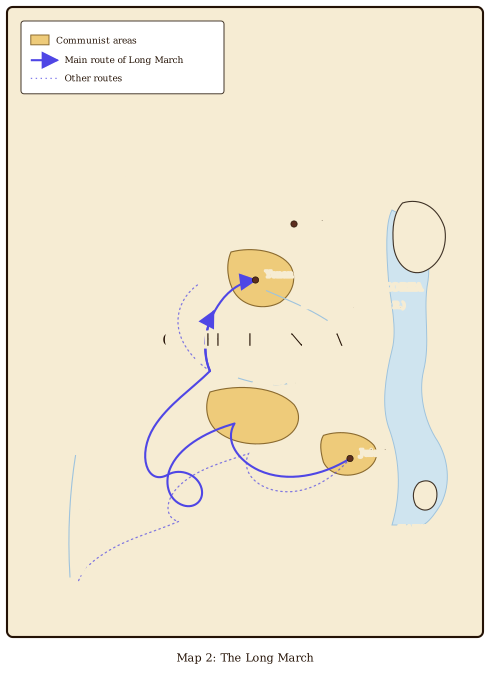
The map is a route map, not a political or physical map of China. Its single subject is the Long March of 1934–35, and it traces the entire journey as a continuous line across the country. The line begins in the southeast, at the communist base in Jiangxi (labelled on the map as Kiangsi), and winds its way generally westward and then northward through a series of provinces, each named on the map: Hunan, Kwangsi (Guangxi), Yunnan, and Szechwan (Sichuan). The route is deliberately shown as long and meandering, cutting through mountainous and difficult terrain, which visually reinforces the text's description of the march as "6,000 gruelling and difficult miles." The line ends in the north at the new communist base, labelled Yenan (Yan'an), in the province of Shanxi.
The map's layout is simple and functional. It shows the whole of China in outline, with the route drawn as a bold, unbroken arrow or line that snakes across the country. The starting point in the southeast and the ending point in the northwest are the two fixed anchors of the map, and the provinces in between are labelled so that a reader can follow the physical progress of the march. There are no battle sites, no dates, no cities other than the two bases, and no other annotations. The map's power comes entirely from the contrast between the two labelled endpoints: the small, encircled communist base in Jiangxi, from which the party was forced to flee, and the new base at Yan'an, where the CCP would rebuild and eventually win power. …
Drawn by us to help you understand the concept clearly, and verified to make sure it's accurate. For exams, practice from your NCERT textbook's own diagram.
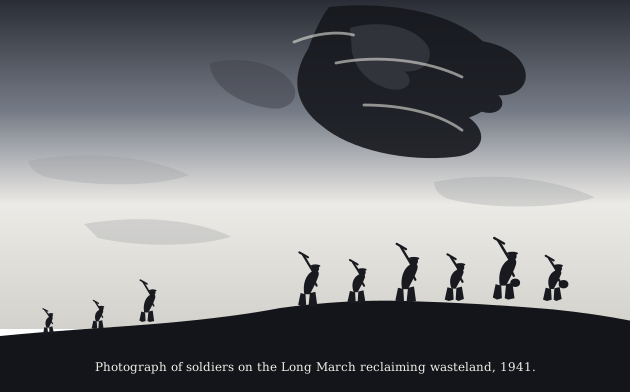
The photograph shows a group of soldiers from the Long March, working together to reclaim wasteland for farming in 1941. They are at the new communist base established after the march, and the image captures them in the act of turning unused or degraded land into cultivable fields. The scene is one of collective labour — soldiers with tools, breaking ground, clearing the land — rather than a posed military portrait. The date, 1941, places this squarely in the period of the war against Japan, when the communists had settled in their Yanan base and were working to build a self-sufficient rural economy.
What the image teaches is central to understanding Mao Zedong’s departure from orthodox Marxism. The Long March had ended in 1935, and the communists were now isolated in a poor, remote region, blockaded by the Guomindang. They could not rely on supplies from outside, nor on the urban working class that classical Marxist theory said would lead the revolution. Instead, survival and political strength had to come from the land itself and from the peasants who worked it. Soldiers reclaiming wasteland is therefore not a minor logistical detail — it is the physical expression of Mao’s core idea that the peasantry, not the urban proletariat, would be the engine of revolution, and that the party must root itself in the countryside by improving rural life directly. …