History · Ch 7 — Paths to Modernisation
Reforms from 1978
Reforms from 1978
The Cultural Revolution did not end in a single stroke; it was followed by a period of intense political manoeuvring within the Chinese Communist Party. Out of this struggle, Deng Xiaoping emerged with a distinctive strategy: keep the Party's political control absolute, but loosen the economy. This was the birth of the socialist market economy — a system where market forces would drive production and growth, but the commanding heights of politics and ideology would remain firmly in Party hands.
Drawn by us to help you understand the concept clearly, and verified to make sure it's accurate. For exams, practice from your NCERT textbook's own diagram.
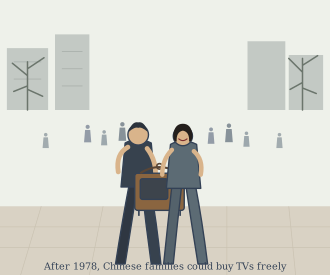
The photograph captures a street scene in China shortly after the 1978 reforms. The focus is on two people carrying a television set slung on a pole between them, a heavy, bulky object that would have been a major household purchase. Around them is a crowd, suggesting a busy public space — a street or market area — where the movement of goods and people was becoming a normal part of daily life.
The television itself is the central object. It is not a small portable set but a large, boxy model, the kind that would sit on a stand in a family living room. The fact that it is being carried home manually, rather than delivered by a shop or vehicle, tells you something important about the era: consumer goods were still scarce enough that buying one was an event, and the physical act of transporting it was part of the experience. The pole and the two carriers also hint at a communal effort — this was not a casual purchase but a significant acquisition for a household.
What the image teaches is the visible, material change that the 1978 reforms brought to ordinary Chinese life. Before this period, consumer goods like televisions were rationed or simply unavailable to most families. The photograph shows the moment when that began to shift — when a household could actually own a television, and when the act of buying one was new enough to be worth photographing. The crowd around the carriers suggests curiosity and interest; people are watching, perhaps because the sight of a new television being brought home was still unusual. …
In 1978, the Party formally declared its goal as the Four Modernisations. These were the four sectors that China would now pour its energy into developing: science, industry, agriculture, and defence. The name itself tells you the priority — modernisation was the new national mission, replacing the class struggle of the Cultural Revolution decade.
What made this period feel genuinely new was the shift in intellectual climate. The Party allowed debate and discussion to flourish — but with one hard boundary: the Party itself could not be questioned. Within that limit, however, the space for ideas was wide open.
The result was an explosion of creative and critical thought that many contemporaries compared directly to the May Fourth movement of sixty years earlier. That earlier moment, in 1919, had been China's great awakening of new ideas — a burst of intellectual energy that reshaped the nation's culture and politics. Now, in the late 1970s, a similar ferment returned. Writers, artists, students and intellectuals began to test the new limits, producing a vibrant, liberating climate of fresh thinking across literature, the arts and social debate. …