History · Ch 4 — The Three Orders
A Fourth Order? New Towns and Townspeople
A Fourth Order? New Towns and Townspeople
The story of the Third Order is not just about peasants and lords in the countryside. By the eleventh century, a new social group was emerging in the towns, one that did not fit neatly into the old division of those who pray, those who fight, and those who work the land. …
Drawn by us to help you understand the concept clearly, and verified to make sure it's accurate. For exams, practice from your NCERT textbook's own diagram.
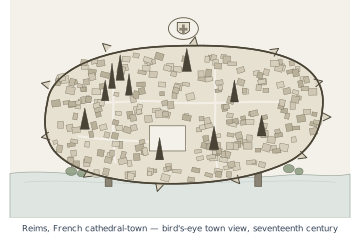
A bird’s-eye view of Reims from the seventeenth century is not a photograph of the Middle Ages, but it is the next best thing: a town that had kept its medieval bones. The image shows a dense, walled settlement, its streets packed into a tight grid inside a ring of fortifications. Above the low rooftops rise the spires of the cathedral — the single most dominant structure in the town. A central square opens up among the buildings, the kind of open space where a market would have been held. Around the whole town runs a moat or river, and the same waterway also cuts through the interior, threading past the walls and houses.
What the figure teaches is that a medieval town was not a random scatter of houses. It was a deliberate, enclosed space, and its shape tells you what it was for. The walls mark it off from the open countryside — a town was a place of privilege, with its own laws and its own protection. The cathedral spires rising above everything show that the church was not just a building in the town but the reason the town existed at all. Reims grew up around its great church, and the figure makes that visible: the tallest structures are not houses or shops but the towers of the cathedral. …