History · Ch 4 — The Three Orders
Monks
Monks
Monks were the most educated members of the clergy, and their lives were devoted entirely to prayer, study, and the copying of manuscripts.
Drawn by us to help you understand the concept clearly, and verified to make sure it's accurate. For exams, practice from your NCERT textbook's own diagram.
A single monk sits at the heart of this woodcut, alone in a room built for work. He is bent over a carved writing-desk, pen in hand, copying a manuscript page laid out before him. The desk itself is substantial, solid wood, clearly a piece of furniture made to last — not a temporary table but a permanent station for daily labour. Around him, filling the space, are shelves lined with books and scrolls. These are not decorative; they are the tools of his trade, the raw material he draws from and the finished products he adds to.
The scene is a scriptorium, the room in a Benedictine abbey set aside for the copying of texts. But the woodcut does not show a grand hall or a team of scribes. It shows one man, one desk, one pen. That isolation is the point. The Rule of St Benedict did not treat writing as a luxury or a scholarly indulgence. It classified it as manual labour — work of the hands, on par with farming, cooking, or cleaning. For a monk who could read and write, this was his assigned chore, his contribution to the community's survival and worship.
What the image teaches is that the monastery was a working institution, not just a place of prayer. Every book on those shelves was produced by exactly this kind of patient, physical effort — hours of sitting, dipping a pen, forming letters, correcting mistakes. The monk's posture, his focus on the page, his hand on the pen: all of it signals that this is serious, repetitive, bodily work. The sacred reading that the Rule demanded — lectio divina — depended on these manuscripts existing, and they existed because monks like this one made them. …
They lived apart from the world in monasteries, following strict rules of discipline and obedience under an abbot.
In Benedictine monasteries, there was a manuscript with 73 chapters of rules which were followed by monks for many centuries. Here are some of the rules they had to follow:
- Chapter 6: Permission to speak should rarely be granted to monks.
- Chapter 7: Humility means obedience.
- Chapter 33: No monk should own private property.
- Chapter 47: Idleness is the enemy of the soul, so friars and sisters should be occupied at certain times in manual labour, and at fixed hours in sacred reading.
- Chapter 48: The monastery should be laid out in such a way that all necessities be found within its bounds: water, mill, garden, workshops. …
Because they could read and write, monks preserved learning and knowledge through the early medieval centuries, when literacy was rare even among the nobility. …
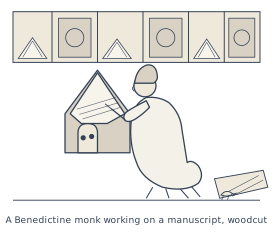
Drawn by us to help you understand the concept clearly, and verified to make sure it's accurate. For exams, practice from your NCERT textbook's own diagram.
A single monk sits at a carved wooden desk, the kind a scribe would use for hours of patient work. His pen is in hand, poised over a page of manuscript, and the image freezes that moment of copying — the careful tracing of letters onto parchment or vellum. Around him, shelves hold books and scrolls, the raw materials and finished products of monastic learning. The scene is quiet, enclosed, and entirely interior: no landscape, no other people, just the monk, his desk, and the collected texts that define his world.
The woodcut captures two things at once. On one level, it is a record of physical labour — the strain of the wrist, the hunch of the shoulders, the sheer manual effort of producing a book by hand. On another, it is a portrait of devotion, because the Rule of St Benedict treated reading and copying as a form of sacred work. For a monk, transcribing a manuscript was not a hobby or an administrative chore; it was a discipline, a way of praying with the hands. The image therefore shows labour and worship fused in a single act.
What the figure teaches about the medieval order of society is more subtle. The monk is not a peasant tilling a field, nor a knight bearing arms — he belongs to the first estate, those who prayed. But the picture refuses to let you see prayer as idle. The desk, the pen, the shelves of books: these are tools of production, and the monk is a worker. The manuscript he copies will be read aloud in the refectory, used in the liturgy, or studied in the cloister. His labour sustains the intellectual and spiritual life of the monastery, and through it, of the Church itself. …