History · Ch 4 — The Three Orders
Cathedral-towns
Cathedral-towns
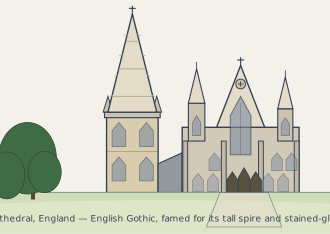
Cathedral-towns grew up around the great churches that bishops and archbishops built, and their very name tells you their origin — they were towns that owed their existence to a cathedral.
Drawn by us to help you understand the concept clearly, and verified to make sure it's accurate. For exams, practice from your NCERT textbook's own diagram.
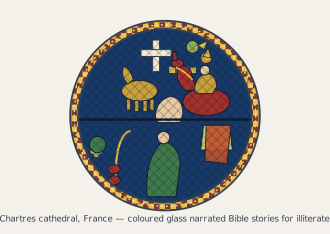
A circular stained-glass window, the kind called a rose window, fills the frame. The glass is cut into a radiating pattern of petals and spokes, and the colours are intense: deep blues and reds dominate, with greens and golds catching the light. The figures inside are dressed in medieval religious clothing — robes and vestments — and they are arranged within the window's compartments, not as a single scene but as a set of framed images that circle outward from the centre.
The window comes from Chartres cathedral in France, and it dates to the fifteenth century. That places it centuries after the period the chapter focuses on, but the style of glass and the way it is used connects directly to what the chapter describes. The description tells us this is exactly the kind of window Abbot Suger says he commissioned for the Abbey of St Denis. Suger was the abbot of St Denis in the twelfth century, and he wrote about wanting glass that was bright enough to be read by worshippers inside the church during the day, and visible by candlelight from outside after dark. That is the key idea: the window is not just decoration. It is meant to be seen, to be read, and to glow.
What the figure teaches is how the medieval church used light and colour as a form of religious instruction. Most people could not read, so the images in glass and sculpture carried the stories and the hierarchy of the faith. The glowing colours were not accidental — they were chosen to create an effect of divine radiance, to make the sacred visible. The fact that the window could be seen from outside at night, lit from within by candles, shows that the church building itself was meant to be a presence in the town, not just a shelter for worship. …
These towns became centres of trade and craftsmanship, attracting merchants and artisans who settled near the cathedral's walls for safety and opportunity. The cathedral itself was not just a place of worship but a symbol of the Church's wealth and power, and its construction drew workers, pilgrims, and business, turning a religious site into a bustling urban hub. …
Abbot Suger (1081–1151), writing about the Abbey of St Denis near Paris, explains why he enlarged the church and commissioned its stained-glass windows:
'Because of the inadequacy which we often felt on feast days, for the narrowness of the place forced the women to run towards the altar upon the heads of the men with much anguish and noisy confusion, [we decided] to enlarge and amplify the noble church… We also caused to be painted, by the exquisite hands of many masters from different regions, a splendid variety of new windows… Because these windows are very valuable on account of their wonderful execution and the profuse expenditure of painted glass and sapphire glass, we appointed an official master craftsman for their protection, and also a goldsmith…who would receive their allowances, namely, coins from the altar and flour from the common storehouse of the brethren, and who would never neglect their duty, to look after these [works of art].'
— Abbot Suger (1081–1151), about the Abbey of St Denis, near Paris …
Drawn by us to help you understand the concept clearly, and verified to make sure it's accurate. For exams, practice from your NCERT textbook's own diagram.
A circular stained-glass window, called a rose window, fills the frame. It comes from Chartres cathedral in France, and the style of the glass dates it to the fifteenth century. The window is built from dozens of individual pieces of coloured glass held together by thin strips of lead, and the whole design radiates outward from a central point like the petals of a flower.
The figures shown are dressed in medieval religious clothing — robes and vestments of the kind worn by clergy, saints, or biblical characters. They are not portraits of real people but stylised, symbolic figures, each placed within its own section of the window. The glass itself is the real subject: deep blues, bright reds, greens, and gold glow against the light, so that the window reads as a wall of luminous colour rather than a simple picture.
What this window teaches is how medieval church architecture used light as a form of worship. The glass is not merely decorative — it was designed to be seen in two ways. By day, sunlight passing through the coloured panes fills the interior of the cathedral with coloured light, so that worshippers inside can "read" the biblical stories and holy figures even if they cannot read text. By night, candlelight from within the church shines outward through the same glass, making the window visible from outside after dark. The window thus works in both directions, carrying the sacred presence of the church into the world and drawing the world's gaze toward the church. …