History · Ch 4 — The Three Orders
An Introduction to Feudalism
An Introduction to Feudalism
Feudalism was not a sudden invention but a slow, organic growth rooted in the conditions of early medieval Europe. It emerged from the fusion of two older traditions: the Roman practice of patronage, where a powerful lord protected a weaker man in exchange for service, and the Germanic custom of personal loyalty between a warrior chief and his followers. Over time, this personal bond of dependence became tied to land, the only real source of wealth and power in an age of constant insecurity. The result was a society built on a chain of mutual obligations, where landholding and loyalty were inseparable, and where every …
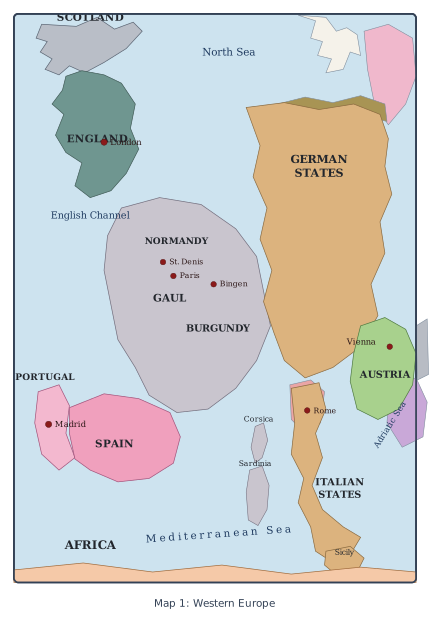
The map is a labelled sketch of western Europe, drawn to anchor every place-name the chapter will use. It shows the political patchwork of the region at the start of the medieval period: England sits across the Channel from Normandy, with Gaul — the land that will become France — to the south and west. To the east lie the German states, and below them Burgundy and Austria, while the Iberian peninsula holds Portugal and Spain. The Italian states occupy the boot-shaped peninsula to the south-east. The map is not a modern political atlas; it is a medieval geography, where kingdoms and duchies overlap and no firm borders exist.
Seven cities are marked, each chosen because it will recur in the narrative. London and Paris anchor the two great monarchies of the north-west. St Denis, just north of Paris, is the burial site of French kings and a centre of royal power. Bingen sits on the Rhine in the German lands, Vienna guards the eastern march of Austria, Madrid stands in the centre of Spain, and Rome is the seat of the papacy in the Italian states. These are not random dots — they are the fixed points around which the story of lords, vassals, and the Church will turn.
The map is set against the Mediterranean Sea to the south, with the coast of Africa sketched along its far shore. That inclusion matters: it reminds the reader that western Europe was not a closed world but a region facing the sea, open to trade, invasion, and cultural contact. The African coast is drawn as a distant edge, not a detailed territory — a hint that the chapter's focus is Europe, but its horizon is wider. …