History · Ch 4 — The Three Orders
The Third Order: Peasants, Free and Unfree
The Third Order: Peasants, Free and Unfree
The Third Order was the vast majority of medieval European society — the peasants who worked the land and fed everyone else. The textbook introduces them by stressing that this order was never a single, uniform mass; it was sharply divided by legal status and by the size of the land they held. The key distinction the chapter draws is between the free peasants, who owned their land outright or held it on easy terms, and the unfree — the serfs — who were tied to the lord's estate and could not leave it without permission. This division, the book explains, shaped not just their daily labour but their entire legal and …
Drawn by us to help you understand the concept clearly, and verified to make sure it's accurate. For exams, practice from your NCERT textbook's own diagram.
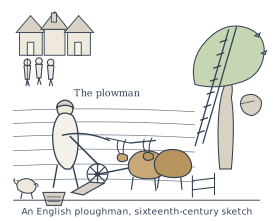
The sketch is a working scene, not a portrait. At the centre stands the ploughman himself, guiding a wheeled plough — the heavy, iron-tipped implement that could cut deep into the northern European clay. Two oxen, yoked in pairs, pull it through open furrowed fields, and the man’s whole posture is bent to the task: one hand on the plough handles, the other on the goad. This is labour in motion, not a posed display.
Around him the artist has packed the ordinary furniture of a medieval village. A dog trots alongside, a basket sits nearby — probably seed or tools — and a fenced enclosure marks off a paddock or garden. In the background, low houses rise, reminding us that this field is not wilderness but the cultivated edge of a settlement. The caption, “The plowman,” is plain and unglamorous, and that plainness is the point: this is a man defined by his function.
What the figure teaches is the heart of the manorial economy — labour rent. Under the manor, both free peasants and serfs owed the lord a fixed number of days of work on his own land, the demesne. This sketch shows exactly that obligation being discharged: the ploughman is not tilling his own strip but the lord’s, and the oxen, plough and field are all part of the lord’s holding. The unpaid nature of the work is invisible in the image, but it is the reason the scene exists at all. …