History · Ch 4 — The Three Orders
Political Changes
Political Changes
The political order of medieval Europe was not static; it was reshaped by the slow decline of feudalism and the rise of centralized monarchies.
Drawn by us to help you understand the concept clearly, and verified to make sure it's accurate. For exams, practice from your NCERT textbook's own diagram.
The figure shows Nemours Castle in France, as it stood in the fifteenth century. You are looking at a stone castle, its most striking feature being round towers capped with conical roofs. These towers rise directly from the castle walls, and the whole structure sits beside a moat — the water encircling or flanking the building, which served both as a defensive barrier and as a visual marker of the lord’s separate, fortified world.
What matters here is not the architecture alone, but the historical moment it captures. Nemours was built in an era when French kings like Louis XI were steadily pulling power toward the crown — centralising administration, curbing the independence of great nobles, and making royal authority felt across the realm. Yet the very existence of this castle shows the limits of that process. The nobility still held their own fortified residences, complete with towers and moats, as private strongholds. A castle like Nemours was a statement: the lord could still raise walls, command a garrison, and defend his lands against rivals or even against the king’s own officers. …
As kings consolidated their power, they began to challenge the traditional authority of the nobility and the Church, drawing support from new social groups like the townspeople and the lesser gentry. This shift was driven by the growing costs of warfare and administration, which pushed monarchs to seek new sources of revenue and loyalty beyond the old feudal bonds. The result was a gradual transformation of governance, wher …
| Date | Event |
|---|---|
| 1461–1559 | New monarchs in France |
| 1474–1556 | New monarchs in Spain |
Drawn by us to help you understand the concept clearly, and verified to make sure it's accurate. For exams, practice from your NCERT textbook's own diagram.
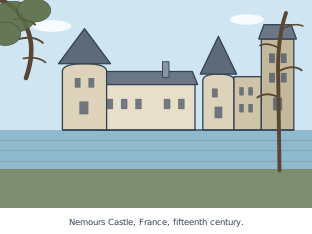
The figure shows Nemours Castle in France as it stood in the fifteenth century. It is a stone castle, built for defence, with round towers capped by conical roofs. A moat surrounds the structure, making the castle a self-contained fortified residence. The image captures the castle as a whole — its walls, towers, and water-filled ditch — rather than any interior scene or individual room.
What matters here is the historical moment the castle represents. The fifteenth century was a time when French kings like Louis XI were steadily centralising royal power, reducing the independence of the great nobles. Yet the nobility still held onto their own fortified homes. Nemours Castle is exactly that: a noble's stronghold, built to protect its lord and his household, with thick stone walls and defensive towers that speak of an age when private warfare and local lordship were still very much alive. …