History · Ch 4 — The Three Orders
England
England
England’s story in this chapter is told as the clearest example of how the three orders — clergy, nobility, and peasantry — actually functioned on the ground. The textbook begins with the Norman Conquest of 1066, when William the Conqueror reshaped the country by granting land to his followers, creating a tightly knit feudal hierarchy. …
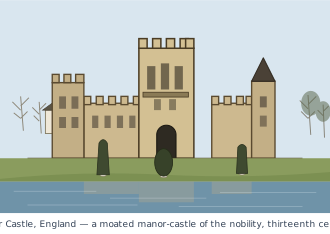
Drawn by us to help you understand the concept clearly, and verified to make sure it's accurate. For exams, practice from your NCERT textbook's own diagram.
The figure shows Hever Castle in England, a fortified stone manor house built in the thirteenth century. The image captures the castle from across its surrounding moat, so the water dominates the foreground. Reflected in the moat are the castle’s crenellated towers — the battlements with their characteristic notched tops — and its mullioned windows, the tall openings divided by vertical stone bars. The stone walls rise directly from the water, making the defensive purpose of the moat immediately visible: an attacker would have to cross open water under fire before even reaching the base of the walls.
The castle itself is a compact, self-contained residence rather than a vast royal palace. Its towers and crenellations mark it as a building designed for defence, but the mullioned windows show it was also a comfortable home, letting in light while remaining narrow enough to resist assault. This combination of domestic comfort and military strength is exactly what a Norman tenant-in-chief would have wanted. After the Norman Conquest of 1066, William the Conqueror distributed land across England to his leading followers, who held it directly from the king. In return they owed him military service and loyalty. A tenant-in-chief of this rank would build a residence like Hever Castle on his newly granted lands — not merely as a home, but as a visible statement of his authority and a stronghold from which to control the surrounding countryside and its peasant labour. …