Q.Write one important property of a paramagnetic material.
Concept understanding — Paramagnetism
Paramagnetism: The Story of Tiny Magnets That Want to Follow
Imagine you're in a dark room with a handful of compass needles scattered on a table. Each needle has its own north-south direction, pointing every which way. Now switch on a big electromagnet nearby. What happens? Each compass needle tries to turn and align with the external field — but thermal jostling (the random shaking from heat) fights that alignment. Some needles succeed, most don't. The result is a weak, partial alignment in the direction of the field.
That is paramagnetism in a nutshell.
The Atomic Picture
Every atom or molecule in a paramagnetic material carries a permanent magnetic dipole moment — a tiny, built-in magnet. This moment comes from unpaired electrons in the atom's orbitals. In most materials, electrons pair up and their magnetic moments cancel. But in paramagnetic substances (like aluminium, platinum, or oxygen gas), some electrons remain unpaired, leaving a net magnetic moment on each atom.
Without an external field, these atomic magnets point in random directions. The material as a whole shows no net magnetisation. Apply a magnetic field, and each tiny magnet experiences a torque that tries to rotate it into alignment with the field. But thermal energy () constantly randomises the directions. The competition between alignment energy () and thermal energy () determines how many moments actually line up.
The Key Result: Curie's Law
For most paramagnets, the magnetisation (the net magnetic moment per unit volume) is proportional to the applied field and inversely proportional to the absolute temperature :
where is the Curie constant (depends on the material). The magnetic susceptibility (roughly in SI) is therefore:
This is Curie's law. The susceptibility is positive (magnetisation is in the same direction as the field) but small — typically to — and it decreases as temperature rises.
The positive sign of distinguishes paramagnetism from diamagnetism (where is negative and temperature-independent). The dependence is the hallmark — heat destroys alignment.
Why Is the Effect So Weak?
Even at room temperature, is much larger than for ordinary fields. For a typical atomic moment J/T and a field T, the alignment energy J, while J at 300 K. That's a factor of 400 difference. Only a tiny fraction of moments align — hence the small susceptibility.
Only at very low temperatures (a few kelvin) or in very strong fields does the alignment become significant. At absolute zero, all moments would align perfectly, giving saturation magnetisation — but that's an ideal limit.
A Common Misconception
Paramagnetism is not the same as ferromagnetism. In a ferromagnet (like iron), atomic moments align spontaneously even without an external field, due to strong quantum-mechanical exchange interactions. Paramagnets have no such interaction — each atomic magnet acts independently. Remove the field, and the alignment vanishes instantly.
The Big Picture
Paramagnetism is the simplest example of how thermal energy competes with an ordering force. The same physics — competition between energy and entropy — appears in countless contexts: the alignment of spins in NMR, the behaviour of magnetic ions in crystals, and even the magnetisation of gases like oxygen (which is paramagnetic and can be pulled by a strong magnet).
The key takeaway: permanent atomic moments + thermal randomness + an external field = weak, temperature-dependent alignment. That's paramagnetism.
Paramagnetism, and its governing Curie's law, is a core CBSE Class 12 Physics NCERT topic, commonly searched as paramagnetic materials examples class 12 physics or Curie's law paramagnetism formula. Its temperature-dependent susceptibility is a favourite numerical topic in both board exams and JEE Main/NEET physics.
Part (a): a paramagnetic material has atoms with a permanent magnetic moment (unpaired electrons) and is weakly attracted by a field.
Part (b): no — diamagnetic atoms have all electrons paired, so their resultant magnetic moment is zero without an external field.
A property of a paramagnetic material
The defining property: each atom/ion of a paramagnetic material carries a permanent magnetic dipole moment arising from unpaired electron spins. Consequences that follow:
- Without a field the moments point randomly, so the bulk magnetisation is zero.
- In a field they partially align, giving a small positive susceptibility and weak attraction into stronger-field regions.
- Alignment is opposed by thermal agitation, so susceptibility falls with temperature — Curie's law .
Paramagnetic atoms have a permanent magnetic moment (unpaired electrons); the material is weakly attracted by a magnetic field, with small positive obeying Curie's law.
Concept understanding — Diamagnetism
Diamagnetism: The Quiet Repulsion
Imagine you bring a magnet near a piece of copper or water. Nothing dramatic happens — no strong pull like iron, no noticeable push. But if you had a very sensitive scale, you'd detect a tiny repulsion. The material is pushed away, ever so slightly. That's diamagnetism.
Why does this happen? The key is that in a diamagnetic material, every atom has zero net magnetic moment to begin with. All its electrons are paired up — each electron's tiny magnetic field is cancelled by its partner. The atom is magnetically neutral.
Now bring an external magnetic field. Something subtle occurs: the field slightly distorts the motion of the orbiting electrons. According to Lenz's law, the electrons respond by creating a tiny induced magnetic moment that opposes the applied field. This is like a weak electromagnetic shield — the material generates its own field pointing opposite to the external one.
This induced moment is temporary. Remove the external field, and the material returns to being magnetically neutral. No permanent magnetism remains.
The result? The material is weakly repelled. The strength of this repulsion is measured by magnetic susceptibility , which for diamagnets is small and negative — typically around to .
The Precise Statement
Diamagnetism is the property of materials whose atoms have no permanent magnetic dipole moment. When placed in an external magnetic field , the orbital motion of electrons induces a magnetic moment opposite to , leading to a negative magnetic susceptibility .
where is electron charge, its mass, and the mean square orbital radius.
The susceptibility is:
- Small in magnitude ()
- Negative (repulsion)
- Independent of temperature — because it arises from orbital motion, not from thermal alignment of permanent moments
Unlike paramagnets and ferromagnets, diamagnetism is present in all materials. But it's usually masked by stronger magnetic effects. Only in materials with no unpaired electrons (like copper, bismuth, water, and most organic compounds) does diamagnetism become the dominant response.
Common Examples
| Material | (approx.) | Behaviour |
|---|---|---|
| Bismuth | Strongest diamagnet among elements | |
| Copper | Weakly repelled | |
| Water | Pure water is diamagnetic | |
| Graphite | Anisotropic — stronger along certain axes |
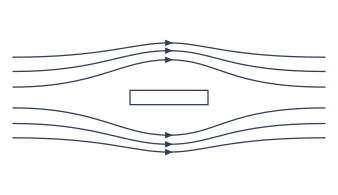
| A common mistake: thinking diamagnets are "non-magnetic". They are magnetic — just very weakly, and in the opposite direction. A diamagnet in a non-uniform field will move toward the weaker field region, not toward the magnet.
Why Temperature Doesn't Matter
In paramagnetism, thermal energy randomises the alignment of permanent atomic moments, so depends on temperature (Curie's law). In diamagnetism, there are no permanent moments to randomise. The induced moment is purely a response to the applied field, arising from the fundamental orbital motion of electrons. Temperature has almost no effect on this — the orbits are fixed by quantum mechanics, not by thermal agitation.
So diamagnetism is universal, weak, temperature-independent, and always repulsive. It's the quiet, ever-present magnetic property that only reveals itself when louder voices are absent.
Diamagnetism is a standard CBSE Class 12 Physics NCERT topic under Magnetism and Matter, frequently searched as diamagnetic materials examples and properties class 12 or why diamagnetism is temperature independent. This concept is regularly paired with paramagnetism and ferromagnetism in comparison-based questions across CBSE boards and JEE Main/NEET physics.
Part (a): a paramagnetic material has atoms with a permanent magnetic moment (unpaired electrons) and is weakly attracted by a field.
Part (b): no — diamagnetic atoms have all electrons paired, so their resultant magnetic moment is zero without an external field.
Do diamagnetic atoms have a resultant moment (no field)?
No. In a diamagnetic substance every electron is paired with another of opposite spin, so the spin magnetic moments cancel; likewise the orbital moments of a filled subshell cancel (). Hence each atom has zero net magnetic moment in the absence of an external field. When a field is applied it induces a small moment opposing the field (Lenz's law at the atomic scale), so a diamagnet is weakly repelled.
No — diamagnetic atoms have zero resultant magnetic moment in the absence of an external field, because all electron moments (spin and orbital) cancel.
Unlock everything free for 14 days
- Full step-by-step solutions
- Concept-first explanations
- Methods, shortcuts & mistakes
- PYQ mapping + timed mock tests
Full access for 14 days. No credit card required.