Q.Draw a block diagram of a generalized communication system and write the functions of
You're viewing a preview — the full solution, concept, methods & PYQ mapping are locked.
Start your 14-day free trial to unlock the full solution →A communication system transfers information from source to destination through a channel; the transmitter processes and launches the signal into the medium, while the receiver extracts and reconstructs the original message from the received signal.
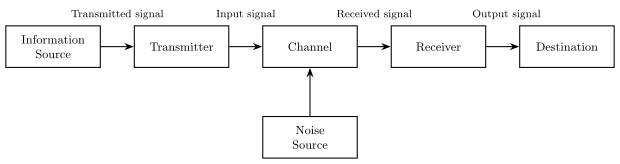
The Big Picture: Why We Need These Components
Every communication system—whether it's a mobile phone call, a radio broadcast, or a fiber-optic internet link—faces the same challenge: how do we move information reliably from one place to another? The answer lies in a chain of processing stages that prepare the message for transmission, send it through a physical medium, and then recover it at the other end.
The transmitter's job is to take a raw message (voice, data, video) and convert it into a form suitable for the channel—amplifying it, modulating it onto a carrier wave, and coupling it to the transmission medium. The receiver does the reverse: it picks up the weak, possibly distorted signal, filters out noise, demodulates it back to baseband, and delivers the original information to the user.
Block Diagram of a Generalized Communication System (described)
A generalized communication system is a chain of five blocks, connected in this order:
Information Source → Transmitter → Channel → Receiver → Destination
with a Noise Source feeding directly into the Channel block (noise is picked up while the signal is in transit, not at the source or the destination).
The five essential blocks are:
| Block | Role |
|---|---|
| Information Source | Generates the message (analog or digital) |
| Transmitter | Processes and sends the signal into the channel |
| Channel | Physical medium (air, cable, fibre) that carries the signal |
| Receiver | Captures and reconstructs the message from the received signal |
| Destination | The end user or device that consumes the information |
Noise enters the system primarily in the channel, degrading signal quality; that is why the noise source is shown feeding into the channel block rather than anywhere else in the chain.
Functions of the Transmitter
The transmitter performs three core operations to prepare the message for transmission:
-
Signal Generation and Transduction
Converts the information source output into an electrical signal. For instance, a microphone turns sound waves into a time-varying voltage .
-
Modulation
Impresses the message signal onto a high-frequency carrier wave . This shifts the signal spectrum to a frequency band suitable for the channel (e.g., radio frequencies for wireless, optical frequencies for fiber). Common schemes include amplitude modulation (AM), frequency modulation (FM), and phase modulation (PM).
-
Amplification and Coupling
Boosts the signal power to a level sufficient to overcome channel losses and noise, then couples it to the transmission medium via an antenna (wireless) or connector (wired).
In digital systems, the transmitter also includes source coding (compression) and channel coding (error-correction codes) before modulation, making the system more efficient and robust.
Functions of the Receiver
The receiver reverses the transmitter's operations and combats the effects of noise: …

Unlock everything free for 14 days
- Full step-by-step solutions
- Concept-first explanations
- Methods, shortcuts & mistakes
- PYQ mapping + timed mock tests
Full access for 14 days. No credit card required.