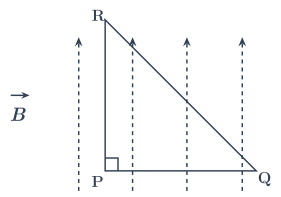
Q.An isosceles right angled current carrying loop PQR is placed in a uniform magnetic field pointing along PR. If the magnetic force acting on the arm PQ is F, then the magnetic force which acts on the arm QR will be (A) (B) (C) (D)
You're viewing a preview — the full solution, concept, methods & PYQ mapping are locked.
Start your 14-day free trial to unlock the full solution →The magnetic force on a current-carrying wire in a uniform field depends only on the vector from start to end of the wire, not its shape. For the isosceles right triangle, the force on QR equals the negative of the force on PQ, so the answer is .
The key insight here is a beautiful simplification: in a uniform magnetic field, the net magnetic force on any current-carrying wire segment depends only on the vector displacement between its endpoints, not on the path the wire takes between them. This is because the force on a small element is , and when is constant, the integral over the wire is just the straight-line vector from start to end.
Let's apply this to the triangular loop.
-
Set up the geometry. The loop PQR is an isosceles right triangle with the right angle at P. So PR and PQ are the perpendicular legs, and QR is the hypotenuse. The uniform magnetic field points along PR. Let's assign directions: take PR along the axis, and PQ along the axis. Then the current direction matters — we need to be consistent. The loop is closed, so current flows P → Q → R → P (or the reverse; the magnitude of force is unaffected by sign, but direction matters for comparing forces).
-
Force on arm PQ. Arm PQ is a straight wire of length (say) along the -axis. The current in PQ flows from P to Q, so is along . The magnetic field is . The force on a straight wire is , where is the vector from P to Q (length , direction ).
Compute: .
So . The magnitude is , and it points out of the plane (say upward). The problem states this force is , so .
-
Force on arm QR. Arm QR is the hypotenuse. Its vector from Q to R: Q is at , R is at (since PR = PQ = L for an isosceles right triangle). So .
The force: .
Compute the cross product term by term:
- .
- . So . …
Unlock everything free for 14 days
- Full step-by-step solutions
- Concept-first explanations
- Methods, shortcuts & mistakes
- PYQ mapping + timed mock tests
Full access for 14 days. No credit card required.