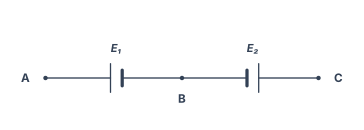
Q.Two cells of emf and () are connected as shown in the figure below. When a potentiometer is used to measure potential difference between the points A and B, the balancing length of the potentiometer wire is 300 cm. But the same potentiometer for the potential difference between points A and C, gives the balancing length 100 cm. Find .
You're viewing a preview — the full solution, concept, methods & PYQ mapping are locked.
Start your 14-day free trial to unlock the full solution →The potentiometer measures potential differences directly proportional to balancing lengths. Between A and B we measure (300 cm); between A and C we measure (100 cm) because the cells oppose. Solving gives .
Why this approach works
A potentiometer compares an unknown potential difference against a known, uniform potential gradient along a wire. At balance, no current flows through the test circuit, so we measure the true emf (or potential difference) without any internal-resistance drop. The key principle: balancing length is directly proportional to the potential difference being measured.
When two cells are connected in series, their emfs add if they aid one another (both driving current the same way) and subtract if they oppose. Here, tracing from A to C, we pass through (A to B) and then (B to C). The figure shows the cells arranged so that their polarities oppose along the path from A to C, making the net potential difference .
Step-by-step solution
- Identify what each measurement gives. The potentiometer wire has a uniform potential gradient, say volts per cm. When we balance the potential difference between A and B, we find a length cm. This measures the emf of the first cell:
- Interpret the second measurement. Balancing between A and C gives cm. Walking from A to C, we go through both cells. Because and they oppose (one tries to raise the potential from A to B, the other tries to lower it from B to C), the net potential difference is:
- Set up the ratio. …
Unlock everything free for 14 days
- Full step-by-step solutions
- Concept-first explanations
- Methods, shortcuts & mistakes
- PYQ mapping + timed mock tests
Full access for 14 days. No credit card required.