Q.(a) Using the necessary ray diagram, derive the mirror formula for a concave mirror.
You're viewing a preview — the full solution, concept, methods & PYQ mapping are locked.
Start your 14-day free trial to unlock the full solution →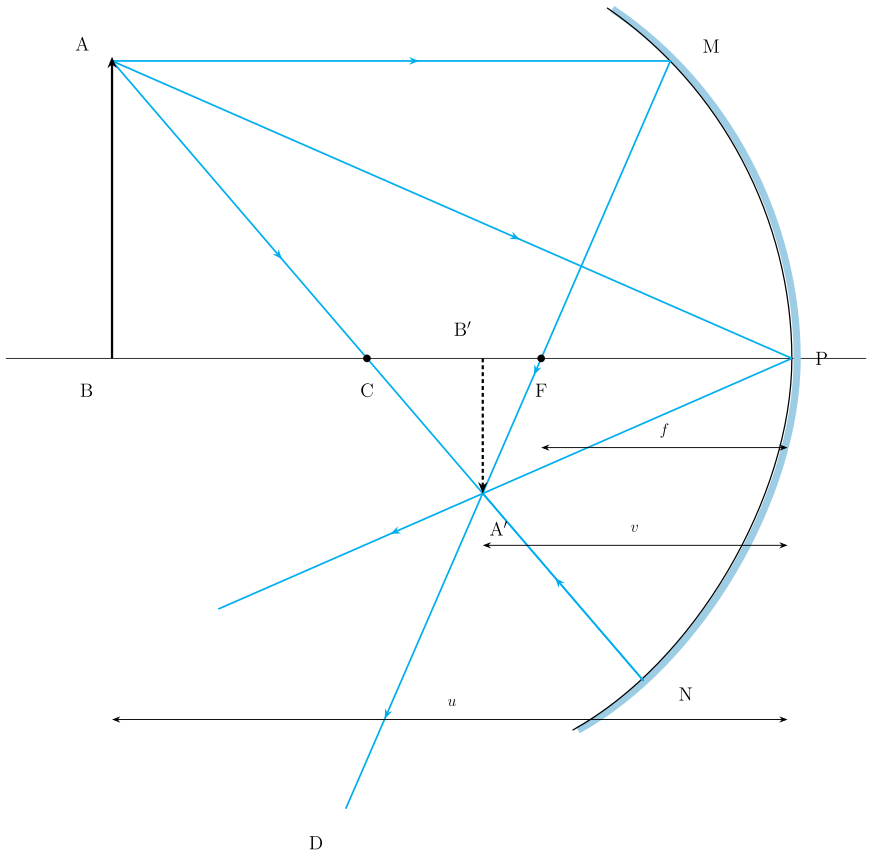
The mirror formula relates object distance, image distance, and focal length for a concave mirror. When a scale lies along the principal axis, different points are at different object distances, producing unequal magnifications—hence non-equidistant image markings.
Part (a): Derivation of the Mirror Formula
The mirror formula connects three fundamental quantities: where you place an object (), where its image forms (), and the mirror's focal length (). The derivation rests on the geometry of similar triangles formed by rays reflecting off the mirror.
The Ray Diagram
Consider a concave mirror with pole , principal focus , and center of curvature . Place an object on the principal axis with on the axis and perpendicular to it.
        B'
        |
    F   |   C
----+---+---+----
    |       |
    |       B
    A'      A

    P (pole)
Two key rays from point :
- A ray parallel to the principal axis reflects through
- A ray through reflects back along itself
These rays intersect at , forming the inverted image .
Setting up the geometry
Let:
- Object distance: (negative by sign convention)
- Image distance: (negative for real image)
- Focal length: (negative for concave mirror)
- Object height:
- Image height: (negative for inverted image)
Step-by-step derivation
-
Identify similar triangles from the parallel ray
The incident ray from parallel to the axis and its reflected ray through create two similar triangles: and .
From similarity:
In terms of our variables:
-
Identify similar triangles involving the focal point
Consider the ray through . The triangles and (where is the perpendicular from the parallel ray at the mirror surface) are similar.
More directly, triangles and (where is on the mirror) give us:
Since (the incident ray height equals object height):
-
Equate the two magnification expressions
From steps 1 and 2:
- Cross-multiply and simplify
- Divide throughout by
This is the mirror formula, valid for all spherical mirrors with appropriate sign conventions.
Remember: all distances are measured from the pole. For a concave mirror, , , and are all negative for real objects and real images in the standard (New Cartesian) sign convention.
Part (b): Non-equidistant Image Markings
When a measuring scale lies along the principal axis, each marking is at a different distance from the mirror. This creates a fascinating effect.
Why magnification varies along the axis
The linear magnification is given by:
Since depends on through the mirror formula, different object distances produce different image distances—and crucially, different magnifications.
The mathematical reason
Consider two consecutive markings on the scale at distances and from the pole, separated by a small distance . …
Unlock everything free for 14 days
- Full step-by-step solutions
- Concept-first explanations
- Methods, shortcuts & mistakes
- PYQ mapping + timed mock tests
Full access for 14 days. No credit card required.