Q.(a) Differentiate between the random velocity and the drift velocity of electrons in an electrical conductor. Give their order of magnitudes.
You're viewing a preview — the full solution, concept, methods & PYQ mapping are locked.
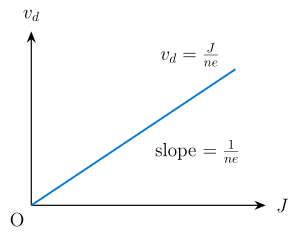
Start your 14-day free trial to unlock the full solution →Random thermal velocity ( m/s) is the chaotic motion of electrons due to heat, while drift velocity ( m/s) is the slow net motion due to an applied electric field. Drift velocity is directly proportional to current density, giving a straight line through the origin.
The Concept: Why Electrons Move So Slowly Yet Current Flows So Fast
When you flip a switch, the light comes on instantly. But the electrons themselves crawl along at a snail's pace — about 0.1 mm per second. How is that possible? The answer lies in distinguishing two very different kinds of motion.
Inside a conductor, electrons are always in random thermal motion, like a swarm of bees. This is random velocity — it exists even when no voltage is applied. Its magnitude is enormous: roughly m/s at room temperature. But because the motion is in all directions, it produces zero net current.
When you apply a voltage, you superimpose a tiny drift on top of this chaos. The drift velocity is the average net velocity of electrons in the direction opposite to the electric field. It's incredibly small — typically m/s — because electrons keep colliding with atoms and losing their directed motion.
A common mistake is to think that the drift velocity is the speed at which electrical signals travel. It is not. The signal travels at nearly the speed of light (as an electromagnetic wave), while the electrons themselves barely move.
Part (a): Random Velocity vs Drift Velocity
Let's break down the differences systematically:
-
Origin: Random velocity arises from thermal energy ( per electron). Drift velocity arises from an applied electric field that accelerates electrons between collisions.
-
Nature: Random velocity is completely isotropic — equal probability in all directions. Drift velocity has a fixed direction (opposite to the field for electrons, since they are negatively charged).
-
Magnitude:
- Random velocity: m/s at 300 K
- Drift velocity: m/s for typical fields in conductors
TipThe ratio is about — random motion is a billion times faster! Yet the drift, though tiny, is what carries charge.
-
Dependence on current: Random velocity is independent of current. Drift velocity is directly proportional to current density ().
-
Effect of temperature: Random velocity increases with temperature (). Drift velocity decreases with temperature (because collision time decreases as atoms vibrate more).
Part (b): The Graph of vs
The relation between drift velocity and current density comes from the fundamental equation:
where is the number density of free electrons, is the electronic charge, and is the drift velocity.
Rearranging:
Since and are constants for a given conductor, is directly proportional to . The graph is a straight line through the origin. …
Unlock everything free for 14 days
- Full step-by-step solutions
- Concept-first explanations
- Methods, shortcuts & mistakes
- PYQ mapping + timed mock tests
Full access for 14 days. No credit card required.