Q.(a) The density of the nuclear matter is tremendously larger than the physical density of the material. Explain.
You're viewing a preview — the full solution, concept, methods & PYQ mapping are locked.
Start your 14-day free trial to unlock the full solution →Nuclear matter is incredibly dense because nucleons are packed at a fixed, universal density (), far exceeding ordinary matter. Nuclear forces are short-range, attractive at intermediate distances, and repulsive at very short distances — completely unlike the long-range Coulomb force.
(a) Why nuclear matter density is astronomically larger than ordinary material density
The key idea is that nucleons (protons and neutrons) are packed together at a nearly constant density inside any nucleus, regardless of its size. This is the nuclear saturation property.
- Nuclear volume scales with mass number Experiments show that the radius of a nucleus is given by , where (1.2 fm). The volume is
So volume is directly proportional to , the number of nucleons.
-
Mass of the nucleus
The mass is roughly (the mass of one nucleon).
-
Density calculation
The cancels out! Evaluating:
- Comparison with ordinary matter The density of water is , iron is about . Nuclear density is roughly times larger. Why? Ordinary matter is mostly empty space — atoms are mostly vacuum between the nucleus and electrons. In nuclear matter, nucleons touch each other with no wasted space.
A common mistake is to think nuclear density varies with element. It does not — all nuclei have nearly the same density because the strong force saturates. A sugar-cube-sized piece of nuclear matter would weigh about 200 million tonnes.
(b) Why nuclear forces are not Coulomb forces between nucleons
The Coulomb force acts between charged particles and is long-range (). Nuclear forces are fundamentally different.
-
Range
Coulomb force between two protons extends to infinity. Nuclear force drops to zero beyond about fm (femtometers). It is a short-range force.
-
Charge independence
The nuclear force between two protons, two neutrons, or a proton and a neutron is approximately the same (ignoring the small Coulomb repulsion between protons). Coulomb force only acts between charged particles — neutrons feel no Coulomb force at all.
-
Strength
At distances around 1 fm, the nuclear attractive force is about 100 times stronger than the Coulomb repulsion between two protons. This is why nuclei can stay bound despite the electrostatic repulsion.
-
Nature of the force
Coulomb force is described by quantum electrodynamics (exchange of photons). Nuclear force is a residual effect of the strong interaction (exchange of mesons like pions), which binds quarks inside nucleons.
Think of the nuclear force like a very strong, very short-range glue that only works when nucleons are practically touching. Coulomb force is like a weak, long-range rubber band that works even at a distance.
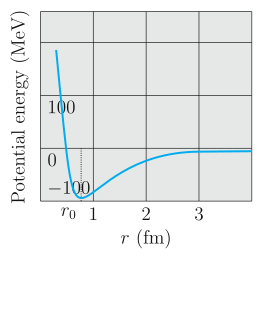
(c) Plot of potential energy between a pair of nucleons
The potential energy between two nucleons as a function of separation has a characteristic shape: …
Unlock everything free for 14 days
- Full step-by-step solutions
- Concept-first explanations
- Methods, shortcuts & mistakes
- PYQ mapping + timed mock tests
Full access for 14 days. No credit card required.