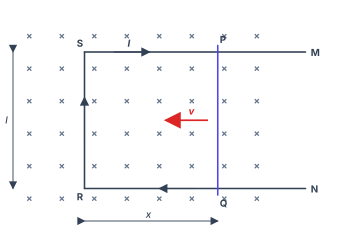
Q.Figure shows a rectangular conductor PSRQ in which the movable arm PQ has resistance and the resistance of PSRQ is negligible. When PQ is moved with a velocity , the magnitude of the emf induced does not depend on :
You're viewing a preview — the full solution, concept, methods & PYQ mapping are locked.
Start your 14-day free trial to unlock the full solution →The induced emf in a moving conductor in a uniform magnetic field is purely a motional emf given by , which depends only on the magnetic field , the length of the moving arm, and its velocity . The resistance of the arm does not appear in this expression — it only determines the current that flows. Hence the correct answer is (c).
The key idea here is the distinction between induced emf and induced current. Many students mix them up, especially when a problem mentions resistance. Let's clear that up first.
When a conductor moves in a magnetic field, the free electrons inside it experience a magnetic Lorentz force . This force pushes charges along the conductor, creating a potential difference — that potential difference is the motional emf. It is a direct consequence of the motion and the field, nothing else.
The resistance of the conductor only comes into the picture when you ask: "How much current flows as a result of this emf?" That's Ohm's law: . But the emf itself is independent of the resistance.
Now let's walk through the problem step by step.
-
Identify the source of emf. The arm PQ is the only part of the loop that is moving. The rest of the loop (PSRQ) is stationary and has negligible resistance. So the entire induced emf in the loop is generated across PQ.
-
Write the expression for motional emf. For a straight conductor of length moving with velocity perpendicular to a uniform magnetic field , the motional emf is:
This is derived from the work done per unit charge by the magnetic force: , so the electric field set up inside the conductor is , and over length , the potential difference is .
- Check each option against this formula.
- (a) magnetic field — appears in . So emf does depend on it.
- (b) velocity — appears directly. So emf does depend on it.
- (d) length of PQ — that's in the formula. So emf does depend on it.
- (c) resistance — does not appear in . So emf does not depend on it. …
Unlock everything free for 14 days
- Full step-by-step solutions
- Concept-first explanations
- Methods, shortcuts & mistakes
- PYQ mapping + timed mock tests
Full access for 14 days. No credit card required.