Q.(a) How does resistance differ from impedance? With the help of a suitable phasor diagram, obtain an expression for the impedance of a series LCR circuit connected to a source v=vmsinωt.
🔒You're viewing a preview — the full solution, concept, methods & PYQ mapping are locked.
🔒 Start your 14-day free trial to unlock the full solution →Part (a)Concept understanding — Parallel AC Circuit Impedance and Current Phasors
Parallel AC Circuit Impedance and Current Phasors
When branches are in parallel across an ac source v=vmsinωt, every branch shares the same voltage, so the natural quantities to add are the branch currents, not the branch voltages. The total current is the phasor sum i=i1+i2.
Branch Currents
A pure resistor draws i1 in phase with v, amplitude vm/R. A series L–C branch has net reactance X=XL−XC=ωL−ωC1; it draws i2 of amplitude vm/∣X∣, lagging v by 90∘ when XL>XC (net inductive) or leading by 90∘ when XC>XL (net capacitive).
Combining the Branch Currents
Because i1 (along v) and i2 (perpendicular to v) are 90∘ apart, the resultant amplitude is
im=i12+i22=vmR21+(XL−XC1)2,
and the current makes a phase angle ϕ with the voltage given by tanϕ=i2/i1.
Impedance
Writing im=vm/Z, the admittances add in quadrature:
Z1=R21+(XL−XC1)2.
What Happens Near Resonance …
Part (b)Concept understanding — Resonance in AC Circuits
Resonance in AC Circuits
A series circuit containing a resistor R, an inductor L and a capacitor C driven by an AC source exhibits resonance — a sharp condition at which the circuit responds most strongly.
The Competing Reactances
In a series RLC circuit the inductor and capacitor oppose the current in opposite senses. Their reactances are
XL=ωL,XC=ωC1
where ω=2πf is the angular frequency. As frequency rises, XL grows while XC shrinks. The total impedance is
Z=R2+(XL−XC)2
The Resonance Condition
At one special frequency the two reactances become exactly equal and cancel:
XL=XC⇒ω0L=ω0C1⇒ω0=LC1
The corresponding resonant frequency is
f0=2πLC1
At this frequency the impedance falls to its minimum, Z=R (purely resistive), so the current reaches its maximum value
Imax=RVrms
Because the reactances cancel, the source voltage and current are exactly in phase — the power factor is 1 at resonance.
Physical Picture
At resonance energy sloshes back and forth entirely between the inductor's magnetic field and the capacitor's electric field, cycle after cycle. The source only has to make up the small amount of energy lost as heat in R. This is the electrical analogue of a swing pushed at its natural frequency: a small periodic drive builds a large oscillation.
Sharpness and the Q-factor
How sharply the current peaks around f0 is measured by the quality factor:
Q=Rω0L=R1CL
A large Q (small R) gives a tall, narrow resonance curve — the circuit is highly selective, responding to a very narrow band of frequencies. A small Q gives a broad, flat peak.
Why It Matters …
Why this formula?
Resonance in AC Circuits: Why the Key Formulas Hold
Resonance in an AC circuit occurs when the inductive reactance (XL) and capacitive reactance (XC) exactly cancel each other out. Let's build the understanding step-by-step.
1. The Core Condition for Resonance
Consider a series RLC circuit (resistor R, inductor L, capacitor C) driven by an AC voltage source V=V0sin(ωt).
The total impedance Z of the series combination is:
Z=R+j(XL−XC)
where:
- XL=ωL (inductive reactance)
- XC=ωC1 (capacitive reactance)
- j=−1
Why resonance happens:
The circuit "wants" to let maximum current flow. The opposition to current comes from both resistance and reactance. But reactance can be negative (capacitive) or positive (inductive). When they are equal in magnitude but opposite in sign, they cancel:
XL=XC
This is the fundamental condition — not a formula to memorize, but a logical consequence of impedance minimization.
2. Deriving the Resonant Frequency
From XL=XC:
ωL=ωC1
Multiply both sides by ω:
ω2LC=1
Thus:
ω0=LC1
Since ω=2πf, the resonant frequency in hertz is:
f0=2πLC1
Why this makes sense:
- A larger L or C means the circuit takes longer to "oscillate" — lower frequency.
- A smaller L or C means faster oscillations — higher frequency.
- The product LC controls the natural time scale of the circuit.
3. What Happens at Resonance — Key Consequences
(a) Impedance is Minimum (Purely Resistive)
At resonance, XL−XC=0, so:
Z=R+j(0)=R
Why: The reactive parts cancel, leaving only the resistance. The circuit behaves like a pure resistor.
(b) Current is Maximum
From Ohm's law for AC:
I=ZV
At resonance, Z=R (minimum possible), so current is maximum:
Imax=RV
Why: The opposition to current is smallest when reactance cancels.
(c) Voltage Across L and C Can Be Very Large
The voltage across the inductor:
VL=I⋅XL=RV⋅ω0L
The voltage across the capacitor:
VC=I⋅XC=RV⋅ω0C1
Since XL=XC at resonance, VL=VC in magnitude, but they are 180° out of phase — they cancel each other in the loop.
Why this is important:
If R is small, VL and VC can be many times larger than the source voltage V. This is called voltage magnification — a key concept for tuned circuits and filters.
--- …
Part (a)
Resistance R opposes current in both dc and ac and is frequency-independent; impedance Z is the total opposition in an ac circuit (from R, XL, XC) and depends on frequency, introducing a phase difference between V and I. In a series LCR circuit, the phasors give VR along I, VL leading and VC lagging by 90∘, so Vm=VR2+(VL−VC)2 and …
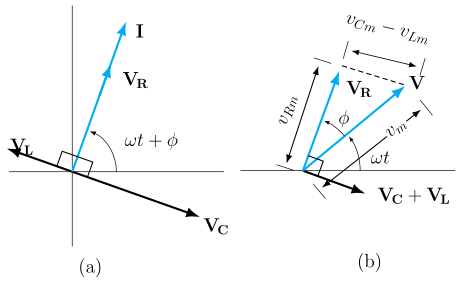
Part (a): R is frequency-independent, Z=R2+(XL−XC)2 depends on frequency and causes a phase shift.
Part (b): resonance at XL=XC⇒f0=2πLC1 (depends on L,C); current is maximum there.
Part (a)
Resistance vs impedance. Resistance R is the opposition to current offered by a resistor; it is the same for dc and ac and does not depend on frequency, and the voltage and current stay in phase. Impedance Z is the effective opposition of an ac circuit that also contains inductance and/or capacitance; it depends on the source frequency and produces a phase difference ϕ between voltage and current.
Series LCR impedance (phasor method). The same current i=imsinωt flows through R, L, C. On a phasor diagram, taking I as reference:
- VR=imR is in phase with I,
- VL=imXL leads I by 90∘,
- VC=imXC lags I by 90∘.
VL and VC are opposite, so their resultant is (VL−VC). Combining with VR at right angles:
vm=VR2+(VL−VC)2=imR2+(XL−XC)2.
Hence the impedance …
Showing the 12 most recent of 31 on this concept.
- CBSE 2026Set 55/1/11 markMCQQ.In a series LCR circuit, the voltage across the resistor, capacitor and inductor is 10 V each. If the capacitor is short circuited, the voltage across the inductor will be (A) 10 V (B) 52 V (C) 25 V (D) 102 V
›Reveal solutionSolution
In a series LCR circuit, when each component drops 10 V, the source voltage is 10 V (since VC and VL cancel) and the equal drops imply XL=XC=R. Shorting the capacitor leaves an RL circuit of impedance R2, so the current becomes I′=R210 and the inductor voltage is VL′=I′XL=210=52 V. The answer is (B).
Concept and intuition
The problem gives a series LCR circuit where the voltage across each element — resistor, capacitor, and inductor — is 10 V. That’s a strong clue: in a series circuit, the current is the same through all components, but the voltages are not in phase. The resistor voltage is in phase with current, the inductor voltage leads by 90°, and the capacitor voltage lags by 90°. So the three 10 V readings are phasor magnitudes, not simple arithmetic sums.
The key insight: if the capacitor is shorted, the circuit becomes a simple RL series circuit. The source voltage remains the same (it’s fixed by the supply), but the impedance changes. We need to find the new inductor voltage.
Step-by-step solution
1. Find the source voltage from the initial LCR condition.
In a series LCR circuit, the phasor sum of voltages across R, L, and C equals the source voltage Vs. Since VL and VC are opposite in phase (180° apart), they subtract. Given VR=VL=VC=10 V:
Vs=VR2+(VL−VC)2=102+(10−10)2=10 V
So the source supplies only 10 V. This makes sense: the inductor and capacitor voltages cancel exactly, so the source only “sees” the resistor drop.
TipThis cancellation is the hallmark of resonance in a series LCR circuit — at resonance, XL=XC, and the impedance is purely resistive. Here, VL=VC implies XL=XC, so the circuit is at resonance.
2. Determine the relationship between R and XL (or XC).
At resonance, the current is I=Vs/R=10/R. The voltage across the inductor is VL=IXL=(10/R)XL=10 V. Therefore:
R10XL=10⇒XL=R
So the inductive reactance equals the resistance. Similarly, XC=R as well. …
- CBSE 2026Set V11 markMCQQ.Power factor of a series LCR circuit is maximum when :(a) XL=XC(b) XC=0(c) XL>XC(d) XL<XC
›Reveal solutionSolution
- CBSE 2026Set ANNUAL1 markQ.Write the formula of impedance of LCR circuit.
›Reveal solutionSolution
Z = √(R² + (X_L − X_C)²), with X_L = ωL, X_C = 1/ωC.
In a series LCR circuit, the resistance R is in phase with the current, the inductive reactance X_L = ωL leads by 90°, and the capacitive reactance X_C = 1/ωC lags by 90°. The resistance and the net reactance (X_L − X_C) are perpendicular in the phasor diagram, so they add in quad …
- CBSE 2026Set ANNUAL1 markQ.Write True or False: The quality factor is ω_r L / R.
›Reveal solutionSolution
True — for a series resonant circuit, Q = ω_r L / R.
The quality factor (Q-factor) of a series resonant LCR circuit measures the sharpness of resonance. It is defined as the ratio of the inductive reactance at resonance to the resistance:
Q = ω_r L / R = (1/R)√(L/C),
…
- CBSE 2026Set SEM31 markMCQQ.The condition of getting maximum current in an LCR series circuit is(a) X_L = 0(b) X_C = 0(c) X_L = X_C(d) R = X_L − X_C
›Reveal solutionSolution
A series LCR circuit carries maximum current at resonance, where the inductive and capacitive reactances are equal (X_L = X_C), leaving impedance Z = R minimum. Option (c).
Step 1 — impedance of a series LCR circuit: Z = √(R² + (X_L − X_C)²), from NCERT/CBSE Class 12 Physics, Alternating Current.
…
- CBSE 2025Set D1 markMCQQ.In resonance condition, the frequency of L-C circuit is (A) (1/2π)√(1/LC) (B) 2π√(1/LC) (C) 2π√(LC) (D) (1/2π)√(LC)
›Reveal solutionSolution
At resonance the inductive and capacitive reactances are equal, giving the natural frequency f = 1/(2π√(LC)).
Resonance in an L-C (or series L-C-R) circuit occurs when the inductive reactance equals the capacitive reactance:
XL=XC ⇒ ωL=ωC1
Solving for the angular frequency,
…
- CBSE 2025Set ANNUAL1 markMCQQ.A series LCR circuit fed by an ac source with angular frequency ω acts as a purely resistive circuit, when(a) ωL > 1/ωC(b) ωL < 1/ωC(c) ωL = 1/ωC(d) ω³L = 1/ωC²
›Reveal solutionSolution
A series LCR circuit behaves as purely resistive at resonance, when the inductive and capacitive reactances cancel.
The impedance of a series LCR circuit is
Z=R2+(ωL−ωC1)2 …
- CBSE 2025Set ANNUAL1 markMCQQ.When LCR series circuit is at resonance then the phase angle (phi) between current and voltage is –(a) pi/2(b) pi(c) 2 pi(d) 0
›Reveal solutionSolution
At resonance in a series LCR circuit, current and voltage are exactly in phase.
In a series LCR circuit, the phase angle ϕ between the applied voltage and current is given by tanϕ=RXL−XC, where XL=ωL and XC=ωC1.
…
- CBSE 2025Set ANNUAL1 markMCQQ.The power delivered by the AC source of a circuit becomes maximum when(i) wL = wC(ii) wL = 1/(wC)(iii) wL = -(1/(wC))^2(iv) wL = sqrt(wC)
›Reveal solutionSolution
Maximum power occurs at resonance, wL = 1/(wC).
In a series LCR circuit the impedance is Z=R2+(XL−XC)2 with XL=ωL and XC=1/ωC. Power P=VrmsIrmscosϕ is greatest when Z is minimum (Z = R) and the current is in phase with the voltage. …
- CBSE 2024Set A11 markMCQQ.The resonance phenomenon is exhibited by a circuit only if following components are present(a) L and R(b) R and C(c) L and C(d) None of the above
›Reveal solutionSolution
- CBSE 2024Set ANNUAL1 markMCQQ.In a series LCR circuit, resonant frequency depends on which of the following -(a) LCR(b) CL(c) LC1(d) RC1
›Reveal solutionSolution
Resonance in a series LCR circuit occurs when inductive and capacitive reactances are equal.
…
- CBSE 2024Set ANNUAL1 markMCQQ.For a series L-C-R circuit at resonance, the relation among inductance (L), capacitance (C) and frequency (ω) is(a) ω = LC(b) ω = 1/LC(c) ω = √(L/C)(d) ω = 1/√(LC)
›Reveal solutionSolution
At resonance the inductive and capacitive reactances of a series LCR circuit are equal, giving ω = 1/√(LC).
In a series L-C-R circuit driven by an AC source of angular frequency ω, the total reactance is X = X_L − X_C = ωL − 1/(ωC). The circuit is said to be at resonance when this net reactance is zero, i.e. the impedance is purely resistive (Z = R) and is minimum, so the current is maximum.
Setting X_L = X_C:
ωL = 1/(ωC)
ω² = 1/(LC)
ω = 1/√(LC)
…
🎓Unlock everything free for 14 days
- ✓Full step-by-step solutions
- ✓Concept-first explanations
- ✓Methods, shortcuts & mistakes
- ✓PYQ mapping + timed mock tests
Full access for 14 days. No credit card required.