Q.(a)
🔒You're viewing a preview — the full solution, concept, methods & PYQ mapping are locked.
🔒 Start your 14-day free trial to unlock the full solution →Part (a)Concept understanding — Biot-Savart Law
From Coulomb’s Law to Currents: The Intuition
You already know that a stationary charge creates an electric field that falls off as 1/r2 and points radially away from the charge. But when that charge moves — when it becomes a current — something new appears: a magnetic field. The question is: how does a tiny piece of current produce a tiny piece of magnetic field?
Imagine a very short segment of wire carrying a steady current I. Let its length be dl — so small that we can treat it as a point-like source. This little current element, Idl, is the magnetic analogue of a point charge in electrostatics. Just as Coulomb’s law gives the electric field from a point charge, the Biot-Savart law gives the magnetic field from a current element.
But there’s a crucial difference. The electric field from a point charge points along the line joining the charge to the observation point. The magnetic field from a current element points perpendicular to both the direction of the current and the line joining the element to the point. This perpendicular nature is the heart of magnetism.
The Precise Statement
Consider a current element Idl located at some point. Let r be the position vector from the element to the point P where we want the magnetic field. Then the infinitesimal magnetic field dB at P due to this element is:
dB=4πμ0r2Idl×r^
Here:
- μ0=4π×10−7T⋅m/A is the permeability of free space — a fundamental constant.
- dl points along the direction of the current.
- r^ is a unit vector pointing from the current element to the observation point.
- The cross product dl×r^ gives both the magnitude and direction.
What the Cross Product Tells You
The magnitude of the cross product is ∣dl×r^∣=dl⋅1⋅sinθ, where θ is the angle between dl and r^. So the magnitude of dB is:
dB=4πμ0r2Idlsinθ
This is exactly the form you mentioned: proportional to Idlsinθ/r2. The sinθ factor means:
- When the current element points directly toward or away from P (θ=0 or π), sinθ=0 — no magnetic field is produced along that line.
- When the current element is perpendicular to the line joining it to P (θ=90∘), the field is maximum.
The direction of dB is given by the right-hand rule: curl the fingers of your right hand from dl toward r^, and your thumb points in the direction of dB. This direction is always perpendicular to the plane containing dl and r.
A common mistake is to think dB points along r or along dl. It does neither — it is perpendicular to both. If you ever find yourself drawing dB in the plane of the page when dl and r are also in the page, you are wrong: dB comes out of or goes into the page.
Why the 1/r2 Dependence?
Just like Coulomb’s law, the Biot-Savart law has an inverse-square dependence on distance. This is not a coincidence — both laws emerge from the same underlying structure of electromagnetism. Unlike Coulomb's law, this 1/4π prefactor is not because the field spreads uniformly over a sphere -- the sinθ factor above already shows the elemental field is NOT isotropic, it circulates around the current direction instead. The 1/(4π) here is simply a consequence of the SI 'rationalized' unit convention, chosen so that μ0 appears without a 4π in Ampere's circuital law, ∮B⋅dl=μ0Ienc.
The Total Field: Integration
The Biot-Savart law gives you the field from a single infinitesimal current element. To find the total magnetic field from a complete circuit (a wire of any shape), you must integrate over the entire path: …
Part (b)Concept understanding — Force Between Parallel Wires
Force Between Parallel Current-Carrying Wires
Imagine two long, straight wires placed side by side, each carrying an electric current. You already know that a current-carrying wire creates a magnetic field around it. And you know that a wire placed in a magnetic field experiences a magnetic force. So here, each wire sits inside the magnetic field created by the other wire. That is the whole story — each wire feels a force because of the other wire's magnetic field.
The direction of that force — attraction or repulsion — depends on whether the currents flow in the same direction or opposite directions.
The Intuition
Take two wires with currents in the same direction. Use the right-hand thumb rule: for wire 1, the magnetic field lines circle around it. At the location of wire 2, that field points in a particular direction. Now apply the right-hand rule for force on a current-carrying wire (Fleming's left-hand rule works too): the current in wire 2, crossed with the field from wire 1, gives a force toward wire 1. The same reasoning from wire 2's perspective gives a force on wire 1 toward wire 2. So they attract.
If the currents are opposite, the field directions reverse, and the forces point away from each other — they repel.
A quick memory aid: Same direction → Attract; Opposite direction → Repel. This is the opposite of what you might guess from electric charges, where like charges repel. Don't mix them up.
The Precise Statement
For two long, straight, parallel wires separated by a distance d, carrying steady currents I1 and I2, the magnitude of the force per unit length on either wire is:
LF=2πdμ0I1I2
where μ0=4π×10−7N/A2 is the permeability of free space.
The force is attractive if the currents are in the same direction, repulsive if they are opposite.
Where Does This Formula Come From?
Wire 1 produces a magnetic field at the location of wire 2. The magnitude of that field is:
B1=2πdμ0I1
This field is perpendicular to wire 2. The magnetic force on a length L of wire 2 carrying current I2 in a perpendicular field B1 is:
F=I2LB1
Substitute B1:
F=I2L⋅2πdμ0I1
Divide both sides by L to get force per unit length:
LF=2πdμ0I1I2
That is the entire derivation — two simple steps: field from one wire, then force on the other.
This formula assumes the wires are infinitely long (or at least very long compared to d) and thin. It gives the force per unit length, which is constant along the wires.
The Definition of the Ampere
This effect is so fundamental that it defines the SI unit of current. One ampere is defined as the constant current which, when flowing through two infinitely long, straight, parallel wires of negligible cross-section placed one metre apart in vacuum, produces a force of exactly 2×10⁻⁷ newtons per metre of length between them. …
Part (a)
Biot–Savart: dB=4πμ0r2Idl×r^. Integrating around a loop of radius a (all elements at distance a, dl⊥r^) gives the field at the centre B=2aμ0I, directed along the axis. Revolving electron: I=Te=2πrev=2π×10−101.6×10−19×107=2.55×10⁻³ A. …
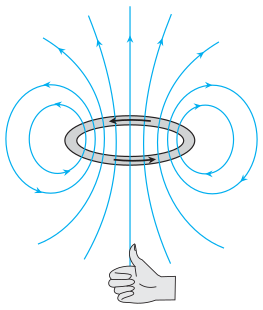
Part (a): Bcentre=2aμ0I; the orbiting electron gives I=2.55×10⁻³ A.
Part (b): F=BILsinθ (max at 90∘, zero at 0∘/180∘); the parallel wires repel with F=1.0×10⁻⁵ N.
Part (a)
- Biot–Savart law. The magnetic field due to a current element Idl at a point at position r is
For a circular loop of radius a carrying current I, every element is at distance a from the centre and dl⊥r^, so ∣dl×r^∣=dl. All elements give field in the same (axial) direction:
dB=4πμ0r2Idl×r^.
The field lines are concentric circles around the wire, and near the centre they are almost straight through the loop, directed along the axis (given by the right-hand rule).B=4πμ0a2I∮dl=4πμ0a2I(2πa)=2aμ0I.
- Current of the revolving electron. The electron completes one orbit in T=v2πr, so the equivalent current is …
Showing the 12 most recent of 18 on this concept.
- CBSE 2026Set ANNUAL1 markMCQQ.Two long parallel wires each carrying a current of 1 A in the same direction, are placed 1 m apart. The force of attraction between them is(a) 2 x 10^7 N/m(b) 2 x 10^-4 N/m(c) 2 x 10^-7 N/m(d) 4 x 10^-7 N/m
›Reveal solutionSolution
Two parallel current-carrying wires attract if their currents are in the same direction; the force per unit length is mu_0I1I2/(2pid).
Each current-carrying wire produces a magnetic field around it, and this field exerts a force on the other current-carrying wire (F = I*L x B). The standard result for the force per unit length between two long straight parallel wires carrying currents I1 and I2, separated by a distance d, is
F/L = mu_0 * I1 * I2 / (2 * pi * d)
…
- CBSE 2026Set ANNUAL1 markMCQQ.Assertion (A): Two infinitely long straight conductors carrying current in the same direction attract each other. Reason (R): The net magnetic field at a point exactly halfway between two infinitely long straight conductors carrying current in the same direction is zero.(a) Both Assertion and Reason are true, and reason is the correct explanation(b) Both Assertion and Reason are true, but the Reason is not the correct explanation(c) Assertion is true, but Reason is false.(d) Assertion is false, but Reason is true.
›Reveal solutionSolution
Both statements are individually correct, but the field being zero at the midpoint is not why the two wires attract each other.
Checking the Assertion: Two infinitely long straight parallel conductors carrying current in the SAME direction do attract each other. Each wire sits in the magnetic field created by the other wire, and using F=IL×B (or the right-hand/Fleming's left-hand rule), the force on each wire due to the other's field points towards the other wire. So the Assertion is TRUE.
Checking the Reason: Take the two wires along the y-axis at x=−a and x=+a, both carrying current I in the +y direction. At the midpoint (origin), using B=2πrμ0Iϕ^ with ϕ^=I^×r^: the field due to the left wire points in +y^′s perpendicular direction (say +z^), while the field due to the right wire (displacement now in −x^ from that wire) points in the opposite transverse direction (−z^). Since both wires are equidistant and carry equal current, these two fields are equal in magnitude and opposite in direction — they cancel exactly. So the net field at the midpoint IS zero when the currents …
- CBSE 2025Set IMPROVEMENT1 markMCQQ.Moving charges produce:(a) Electric field only(b) Magnetic field only(c) Both electric and magnetic fields(d) None of the above
›Reveal solutionSolution
A moving charge is a current element, and every current produces a magnetic field in addition to its own electric field.
A stationary charge produces only an electric field around it. A moving charge, however, constitutes a current, and by Oersted's discovery and the Biot–Savart law, every current-carrying element produces a magnetic field in the region around it — in addition to the electric field the charge alw …
- CBSE 2025Set D1 markMCQQ.Dimensional formula of permeability is (A) [MLT^-2 A^-2] (B) [MLT^2 A^-2] (C) [MLT^2 A^2] (D) [MLT^-2 A]
›Reveal solutionSolution
Using the force per unit length between two wires, μ₀ works out to dimensions [M L T⁻² A⁻²].
The force per unit length between two parallel current-carrying wires is
ℓF=2πdμ0I1I2
Solving for μ₀:
μ0=I1I22πd(F/ℓ)
…
- CBSE 2025Set ANNUAL1 markMCQQ.Biot-Savart law indicates that the moving electrons (velocity v) produce a magnetic field B such that:(a) B∥v(b) It obey inverse cube law(c) It is along the line joining the electron and point of observation(d) B⊥v.
›Reveal solutionSolution
By the Biot-Savart law, the magnetic field due to a moving charge is perpendicular to both its velocity and the position vector to the observation point.
The Biot-Savart law for a point charge q moving with velocity v gives the magnetic field at a point with position vector r (from the charge) as
B=4πμ0r2qv×r^ …
- CBSE 2025Set ANNUAL1 markMCQQ.Assertion: The turns of a spring come close to each other, when current is passed through it. Reason: It is because, the turns of a spring carry current in same direction and hence attract each other.(a) If both assertion and reason are true and reason is the correct explanation of assertion.(b) If both assertion and reason are true but reason is not a correct explanation of assertion.(c) Assertion is true but reason is false.(d) Both assertion and reason are false.
›Reveal solutionSolution
Adjacent turns of a current-carrying spring act like parallel wires carrying current in the same direction, which attract each other by the magnetic force between parallel currents — so the coils are pulled together.
Two straight parallel conductors carrying currents in the SAME direction attract each other (force per unit length F/l=μ0I1I2/2πd, attractive for like-directed currents, repulsive for opposite). A spring is essentially a coil of many closely-spaced turns; each turn carries current in the same sense as its neighbours. Treating adjacent turns as parallel current-carrying wires, they attract each other, so the spring's turns are pulled closer together ( …
- CBSE 2024Set 55/1/11 markMCQQ.For question 15, two statements are given – one labelled Assertion (A) and the other labelled Reason (R). Select the correct answer from the codes (A), (B), (C) and (D) below. (A) Both Assertion (A) and Reason (R) are true and Reason (R) is the correct explanation of the Assertion (A). (B) Both Assertion (A) and Reason (R) are true, but Reason (R) is not the correct explanation of the Assertion (A). (C) Assertion (A) is true, but Reason (R) is false. (D) Assertion (A) is false and Reason (R) is also false. Assertion (A) : Two long parallel wires, freely suspended and connected in series to a battery, move apart. Reason (R) : Two wires carrying current in opposite directions repel each other.
›Reveal solutionSolution
Connected in series, the two freely suspended parallel wires carry equal currents in opposite directions — the current goes out along one wire and returns along the other. Antiparallel currents repel, so the wires move apart. Both statements are true and the Reason is exactly why the wires separate. The correct option is (A).
The physical setup: what does "in series" mean here?
When two long parallel wires hang freely side by side and are joined in series to a battery, there is a single current path: the current leaves the battery, travels along the first wire, crosses over at the far end, and comes back along the second wire to the battery. Because the second wire carries the return current, the two adjacent wires carry equal currents in opposite directions — antiparallel currents.
Force between the wires
Each wire sits in the magnetic field created by the other. For two long parallel wires a distance d apart carrying currents I1 and I2, the force per unit length on either wire is
LF=2πdμ0I1I2
with the standard direction rule: parallel (same-direction) currents attract; antiparallel (opposite-direction) currents repel. You can check this with F=IL×B: for opposite currents, the field of wire 1 at wire 2 gives a force on wire 2 pointing away from wire 1, and by Newton's third law wire 1 is pushed away from wire 2 with equal magnitude.
Evaluating the statements
- Assertion (A): "Two long parallel wires, freely suspended and connected in series to a battery, move apart." As shown above, the series connection makes the currents antiparallel, the wires repel, and — being freely suspended — they move apart. True. …
- CBSE 2024Set ANNUAL1 markQ.Write the vector form of Biot-Savart law.
›Reveal solutionSolution
Biot-Savart law gives the magnetic field due to a small current element as a vector cross product.
…
- CBSE 2024Set A1 markMCQQ.The nature of electron beams moving with uniform velocity in the same direction will be (A) converging (B) diverging (C) parallel (D) none of these
›Reveal solutionSolution
Like charges repel electrostatically; this force exceeds the magnetic attraction at ordinary speeds, so the beams diverge.
Two parallel electron beams experience two effects:
- As parallel currents in the same direction, the magnetic force is attractive.
- As streams of like (negative) charges, the electrostatic force is repulsive. …
- CBSE 2024Set ANNUAL1 markMCQQ.Two long parallel wires each carrying a current of 1 A in the same direction, are placed 1 m apart. The force of attraction between them is(a) 2 x 10^-7 N/m(b) 2 x 10^-4 N/m(c) 1 x 10^-7 N/m(d) 4 x 10^-7 N/m
›Reveal solutionSolution
Two parallel current-carrying wires attract each other (same direction) with a force per unit length given by mu0 I1 I2 / (2pid).
The force per unit length between two long parallel wires carrying currents I1 and I2, separated by distance d, is
lF=2πdμ0I1I2
Substituting μ0=4π×10−7 T m/A, I1=I2=1 A, d=1 m:
lF=2π×14π×10−7×1×1=2×10⁻⁷ N/m
…
- CBSE 2023Set ANNUAL1 markMCQQ.Biot-Savart law gives(a) force between two charges(b) magnetic field produced by electric current(c) force between two magnetic poles(d) electric potential due to a charge
›Reveal solutionSolution
The Biot-Savart law is the fundamental law that gives the magnetic field produced by a current-carrying conductor.
The Biot-Savart law states that the magnetic field dB at a point due to a small current element Idl is
dB=4πμ0r2Idl×r^
…
- CBSE 2023Set ANNUAL1 markQ.Fill in the blank: The force between two parallel current carrying conductors (flowing in the same direction) is __________.
›Reveal solutionSolution
Two parallel current-carrying conductors carrying current in the same direction attract each other.
Each current-carrying conductor sets up a magnetic field around itself (by the Biot-Savart/Ampere law), and the other conductor, carrying current in that field, experiences a force F=BIL (via F=IL×B). Working out the directions with the right-hand rule shows that when the currents flow in the same direction, the force on each conductor points toward the other - i.e. the conductors …
🎓Unlock everything free for 14 days
- ✓Full step-by-step solutions
- ✓Concept-first explanations
- ✓Methods, shortcuts & mistakes
- ✓PYQ mapping + timed mock tests
Full access for 14 days. No credit card required.