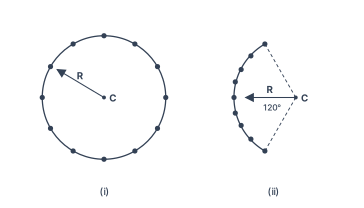
Q.(a) Twelve negative charges of same magnitude are equally spaced and fixed on the circumference of a circle of radius as shown in Fig. (i). Relative to potential being zero at infinity, find the electric potential and electric field at the centre C of the circle.
You're viewing a preview — the full solution, concept, methods & PYQ mapping are locked.
Start your 14-day free trial to unlock the full solution →Electric potential is a scalar that depends only on distance, not on the arrangement of charges; electric field is a vector that depends on symmetry. For twelve equal negative charges at distance from centre : (a) , (by symmetry); (b) (same, because all charges are still at distance ).
The heart of this problem lies in understanding the difference between electric potential and electric field. Potential is a scalar quantity — it adds algebraically without regard to direction. Field is a vector — its components can cancel when charges are symmetrically placed. Both depend on the distance from each charge to the point of interest, but only the field cares about the direction from which each contribution arrives.
When we say "potential is zero at infinity," we're choosing our reference point. The potential at any point due to a collection of point charges is then the algebraic sum of the individual potentials, each given by , where is the distance from charge to the point.
The electric field, on the other hand, is the vector sum of individual fields , where points from the charge toward the point of interest.
Part (a): Twelve charges equally spaced on a full circle
Let each charge have magnitude (we'll take and explicitly write the negative sign). Each charge is at distance from the centre .
1. Electric potential at :
Since all twelve charges are at the same distance from , and potential is a scalar, we simply add:
The negative sign reflects that the charges are negative; the potential is below the zero reference at infinity.
2. Electric field at :
Each charge produces a field pointing toward itself (because the charges are negative). Imagine the twelve charges arranged like the hours on a clock face. The charge at "12 o'clock" produces a field pointing upward (toward 12); the charge at "6 o'clock" produces a field pointing downward (toward 6). These two cancel exactly.
By symmetry, every charge has a partner directly opposite (180° away). The twelve charges form six such pairs, and the field contributions from each pair cancel perfectly. The net electric field at is zero.
Whenever charges are uniformly distributed on a circle (or sphere), the electric field at the centre (or at the centre of the sphere) is always zero by symmetry — but the potential is not zero unless the total charge is zero.
Part (b): Twelve charges unequally spaced on a 120° arc
Now the charges are confined to a 120° arc, and they are unequally spaced along that arc. The key insight: potential depends only on distance, not on angular position.
3. Electric potential at :
Every one of the twelve charges is still at distance from the centre (they lie on a circle of radius , just not uniformly distributed around the full circumference). The potential at is the scalar sum:
…
Unlock everything free for 14 days
- Full step-by-step solutions
- Concept-first explanations
- Methods, shortcuts & mistakes
- PYQ mapping + timed mock tests
Full access for 14 days. No credit card required.