Q.How does Einstein's photoelectric equation explain the emission of electrons from a metal surface? Explain briefly. Plot the variation of photocurrent with :
You're viewing a preview — the full solution, concept, methods & PYQ mapping are locked.
Start your 14-day free trial to unlock the full solution →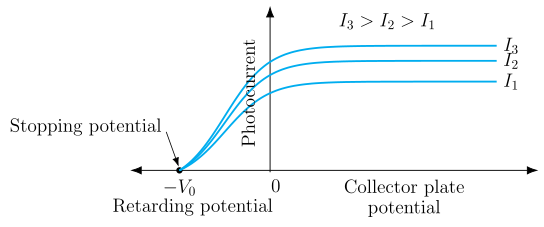
Einstein's photoelectric equation treats light as quanta (photons), each transferring energy to a single electron; emission occurs only when (the work function). Photocurrent depends on intensity (number of photons) but saturation and stopping potential depend only on frequency.
The Conceptual Breakthrough
Classical wave theory predicted that any frequency of light, given enough time, should eject electrons from a metal surface—the wave would gradually transfer energy until the electron escaped. Experiments shattered this picture: below a threshold frequency , no electrons emerged, no matter how intense the light or how long you waited. Bright red light on certain metals produced nothing; dim violet light instantly released electrons.
Einstein resolved this by proposing that light arrives in discrete packets—photons—each carrying energy , where is Planck's constant. When a photon strikes an electron in the metal, it delivers all its energy in a single quantum event. The electron uses part of this energy (the work function ) to escape the metal's surface; whatever remains becomes kinetic energy.
This leads directly to Einstein's photoelectric equation:
where is the maximum kinetic energy of emitted electrons.
Why Electrons Are Emitted
-
Photon absorption is instantaneous: A single photon–electron collision transfers energy in about seconds. No accumulation over time.
-
Threshold condition: For emission, the photon energy must at least match the work function:
Below , each photon is too "weak" to liberate an electron, regardless of how many photons arrive (intensity).
-
Kinetic energy depends only on frequency: Once , the surplus energy becomes the electron's kinetic energy. Doubling the intensity doubles the number of photons (hence the number of emitted electrons, i.e., current) but does not change the energy per photon—so stays the same.
-
Intensity controls photocurrent: Higher intensity means more photons per second, so more electrons ejected per second, yielding larger photocurrent .
A common mistake is thinking that brighter light (higher intensity) will eventually eject electrons even below threshold frequency. It won't—each photon still lacks the minimum energy , and photons don't "pool" their energy.
(a) Photocurrent vs. Collector Plate Potential (for Different Intensities)
When we apply a potential between the emitter and collector plate, we can either assist or retard the emitted electrons.
Setup: Fix the frequency ; vary the collector potential (positive or negative relative to the emitter); measure photocurrent .
Physical reasoning:
-
Positive (accelerating) potential: Electrons are pulled toward the collector. Even the slowest electrons reach it. Current quickly saturates at when all emitted electrons are collected. Increasing further doesn't increase because you can't collect more electrons than are being emitted.
-
Negative (retarding) potential: Electrons are repelled. Only those with kinetic energy (where is electron charge) can overcome the barrier and reach the collector. As becomes more negative, fewer electrons make it through; current drops.
-
Stopping potential : The (negative) potential at which even the fastest electrons (with ) are turned back, so . Energy balance gives:
Crucially, depends only on , not on intensity.
Effect of intensity (at fixed ):
- Higher intensity more photons more electrons emitted per second higher saturation current .
- But remains the same, because is unchanged.
Graph description: with photocurrent on the vertical axis and collector potential on the horizontal axis, the three curves (one per intensity ) all pass through zero current at the same point , rise through , and flatten into horizontal saturation plateaus — the highest plateau for , the lowest for . Only the saturation heights differ between the three curves; the point where each curve crosses the axis is identical. …
Unlock everything free for 14 days
- Full step-by-step solutions
- Concept-first explanations
- Methods, shortcuts & mistakes
- PYQ mapping + timed mock tests
Full access for 14 days. No credit card required.