Q.A point charge, situated at a distance from a short electric dipole on its axis, experiences a force . If the distance of the charge is doubled, the force acting on the charge will be :
The force on a point charge due to a short electric dipole on its axis follows an inverse-cube law. Doubling the distance reduces the force by a factor of 8, so the new force is .
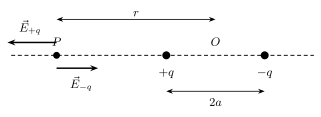
The key here is understanding how the electric field of a dipole behaves with distance. A short electric dipole (two equal and opposite charges separated by a small distance) does not produce a field that falls off like a point charge (). Instead, along its axis, the field falls off as . This is because the fields from the two opposite charges nearly cancel at large distances, leaving a weaker, faster-decaying net field.
Since force on a test charge is , and the test charge itself doesn’t change, the force is directly proportional to the dipole’s electric field at that point. So if the field changes by a factor, the force changes by the same factor.
Let’s work through it step by step.
- Recall the formula for the axial field of a short dipole. For a dipole of dipole moment , at a point on its axis at distance from its centre (where is much larger than the separation between the two charges), the electric field magnitude is:
This is a standard result — the dependence is the hallmark of a dipole field.
- Relate force to field. The force on a point charge placed in this field is simply:
So .
- Now double the distance. Let the initial distance be , giving force . At the new distance , the new force is:
Since , we have:
A very common mistake is to treat the dipole like a point charge and use Coulomb’s inverse-square law. That would give , which is option (c) — a tempting but wrong answer. The dipole’s field decays faster because the two opposite charges partially cancel each other’s effect.
A quick way to remember: monopole (point charge) → , dipole → , quadrupole → , and so on. Each additional “pole” adds one power of in the denominator.
The force becomes , which corresponds to option (b).
Unlock everything free for 14 days
- Full step-by-step solutions
- Concept-first explanations
- Methods, shortcuts & mistakes
- PYQ mapping + timed mock tests
Full access for 14 days. No credit card required.