Biology · Ch 11 — Enhancement of Food Production
Apiculture (Bee-keeping)
Apiculture (Bee-keeping)
D. Apiculture or bee keeping : Apiculture, or bee-keeping, is the artificial rearing of honeybees, undertaken for two linked reasons: to obtain bee products — honey, wax, pollen, bee venom, propolis (bee glue) and royal jelly — and to use the bees as pollinating agents for crop plants. It is described as an ancient cottage industry, and honey itself is valued both as a high-nutritive-value food and for its use in indigenous systems of medicine.
Can you tell?
Why are honey bees called the best pollinators?
Four species of honeybee are found in India: Apis dorsata, the rock bee or wild bee; Apis florea, the little bee; Apis mellifera, the European bee; and Apis indica, the Indian bee. Of these four, only Apis mellifera and Apis indica are actually suited to domesticated rearing, which is why they are specifically called the domesticated species and are the ones used in commercial apiculture.
Knowledge enhancer
For bee keeping, Apis mellifera and Apis indica are the suitable species, hence they are known as the domesticated species.
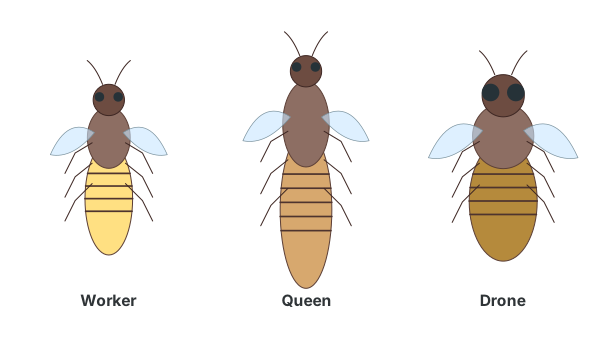
Polymorphism in honey bee : A honeybee colony shows true polymorphism, meaning it is made up of three physically and functionally distinct castes: the queen, the sole fertile female in the colony and normally its largest member; the workers, sterile females who carry out essentially all of the colony's labour — foraging, comb-building, brood care and defence; and the drones, the males, whose principal role is to mate with a queen.
Drawn by us to help you understand the concept clearly, and verified to make sure it's accurate. For exams, practice from your textbook's own diagram.
What this figure shows. This figure depicts the three castes of the honeybee Apis mellifera side by side — the worker, the queen and the drone — showing how they differ in body size and form despite belonging to the same colony. The queen is the sole fertile female and is usually the largest of the three, the workers are sterile females that carry out the colony's foraging, comb-building and brood-care duties, and the drones are the males whose m …
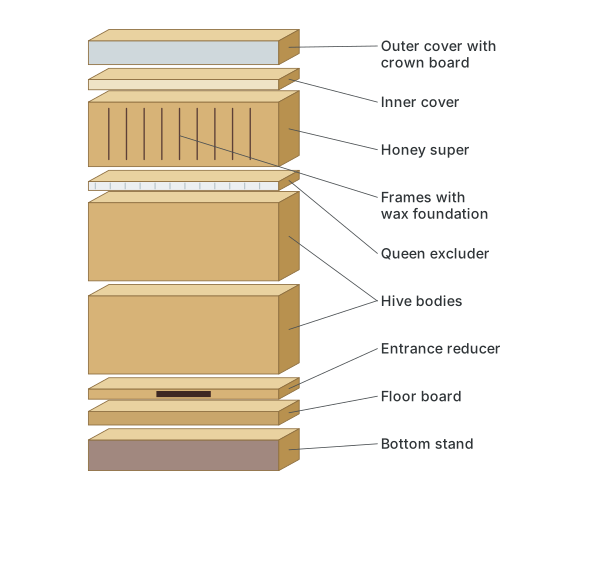
Artificial bee hive : A colony builds its wax comb inside a hive - in the wild a natural hive (the book's Fig. 11.4 is a photograph of one), in apiculture the man-made box hive drawn below. Successful bee-keeping demands familiarity with bee behaviour, careful choice of a suitable location, skill in catching and hiving wild swarms, and ongoing management of the hive across the different seasons, including regular handling and collection of honey, wax and other products. Periodic inspection is essential — checking the cleanliness of the hive boxes, the general activity level of the bees and the queen, the condition of the brood, and the availability of water nearby. A working apiary needs a defined set of equipment: bee-hive boxes fitted with comb-foundation sheets, a bee veil, a smoker, a bee brush, gloves, gumshoes, an uncapping knife, a swarm net, a queen excluder, and general hive tools.
Drawn by us to help you understand the concept clearly, and verified to make sure it's accurate. For exams, practice from your textbook's own diagram.
What this figure shows. This figure is a labelled cutaway of a man-made artificial bee-hive box used in commercial apiculture, showing its stacked components from bottom to top: the bottom stand and floor board, an entrance reducer that controls bee traffic in and out, the main hive body containing frames fitted with wax-foundation sheets on which the bees build comb, a queen excluder that keeps the larger queen confined to the brood chamber, an upper honey super where surplus honey is stored, an inner cov …
…