Biology · Ch 11 — Enhancement of Food Production
Fishery
Fishery
E. Fishery : Fishery is the branch of applied biology dealing with the catching, processing, farming and marketing of fish and other economically useful aquatic animals, including prawns, lobsters, oysters, mussels and crabs. It is organised into three distinct divisions, based on where the fishing or farming takes place.
Inland fishery covers the culturing and capturing of fish from fresh-water bodies — ponds, lakes, dams and rivers — and India's inland aquatic area used for this purpose covers roughly 40 to 50 lakh acres. Common fresh-water fish include Labeo rohita (rohu), Catla, Cirrhina mrigala (mrigal) and various other carp species.
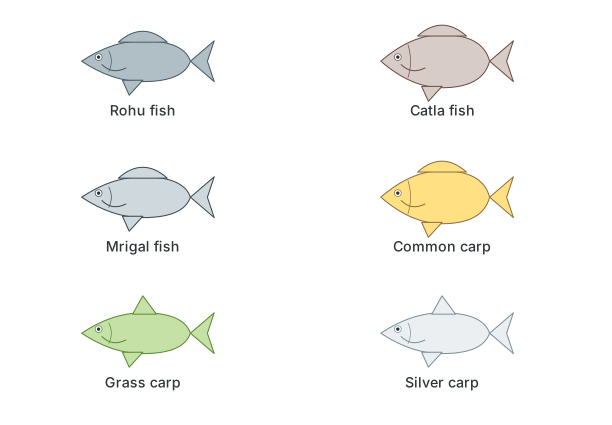
Drawn by us to help you understand the concept clearly, and verified to make sure it's accurate. For exams, practice from your textbook's own diagram.
What this figure shows. This figure presents the common food fishes cultured in Indian inland fresh-water fisheries side by side for comparison, including rohu, catla and mrigal, together with the introduced common carp, grass carp and silver carp, illustrating the typical elongated, scaled carp body shape that these species broadly share while differing in size, colourat …
Knowledge enhancer
Fish farming, or the culturing of edible and commercially important fish, is only possible in fresh-water bodies.
Marine fishery covers fish captured from the sea, along India's roughly 7,500-kilometre-long coastline. Common marine fish named include Harpadon (Bombay duck), Sardinella (sardine), Rastrelliger (mackerel) and Stromateus (pomfret), and prawns and lobsters caught from marine waters have significant market value worldwide.
Estuarine fishery covers fish captured specifically from an estuary — the place where a river meets the sea — with the Sunderban area of West Bengal given as a well-known Indian example.
Can you tell?
- Give the names of the estuaries found in Maharashtra and mention their locations.
- Enlist the names of the different fish found at an estuary.
Running a fish farm. Whatever the setting, maintaining a fish farm involves a common set of factors: choosing a suitable site, excavating ponds, and providing hatchery tanks, nursery tanks, rearing tanks and stocking tanks or ponds, along with a reliable water source, manures and supplementary feed. Culture fishery can be either monoculture, rearing only one species, or polyculture, rearing several species together in the same water body. …