Biology · Ch 11 — Enhancement of Food Production
Lac Culture
Lac Culture
G. Lac culture : Lac culture concerns Trachardia (also called Kerria) lacca, a small, colonial insect whose dermal glands, in the female, secrete a resin-like, pink-coloured substance. The insect feeds on the succulent twigs of specific host plants — ber, peepal, palas, kusum and babool are named — and its secretion hardens into lac on contact with air. Lac is a genuinely complex substance, made up of a large amount of resin together with sugar, water, minerals and alkaline substances, and natural lac as it is first collected is always contaminated with plant and insect debris; the pure form of lac, obtained by washing and filtering out this contamination, is called shellac.
The lac insect is native to India, and India alone accounts for about 85% of the entire world's lac production, which makes lac products a genuinely important part of the rural economy for the farmers who cultivate it. Lac is used to make bangles, toys, woodwork finishes, inks and mirror-backing, among other things, and because natural lac deposition depends on the insect finding a suitable host plant, large-scale lac production requires artificial inoculation of host plants with the insect, to ensure a regular, good-quality and sufficient supply. …
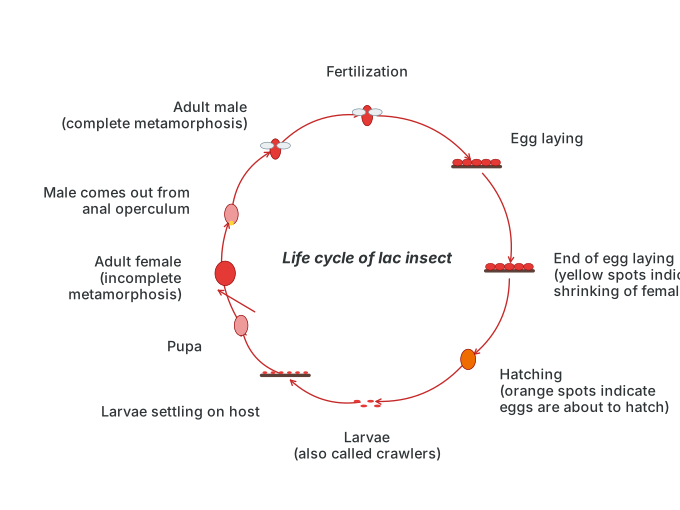
Drawn by us to help you understand the concept clearly, and verified to make sure it's accurate. For exams, practice from your textbook's own diagram.
What this figure shows. This figure diagrams the life cycle of the lac insect on its host twig, showing egg-laying by the settled adult female (with colour cues marking when eggs are about to hatch, shown by orange spots, and when the female is nearing the end of egg-laying, shown by yellow spots as she shrinks), hatching of mobile larvae called crawlers that settle on the host plant, their incomplete metamorphosis into sedentary nymphs and then adult females that secrete the resinous lac covering, and separately the pathway for males, which undergo complete metamorphosis through a pupal stage and emer …