Biology · Ch 3 — Inheritance and Variation
Back Cross and Test Cross
Back Cross and Test Cross
Two related crosses are used to test an individual's genotype against its two parents.
a. Back cross : A back cross is any cross between an F1 hybrid and either one of its two parents (dominant or recessive) — F1 individuals, ordinarily raised to F2 by self-pollination, can instead be crossed back onto a parental line this way.
b. Test cross : A test cross is a specific, and more diagnostically useful, kind of back cross: it always crosses the F1 hybrid with the homozygous recessive parent, never the dominant one. Because every test cross starts from a fully known recessive genotype (tt), the phenotypic ratio of the offspring directly reveals the unknown F1's genotype.
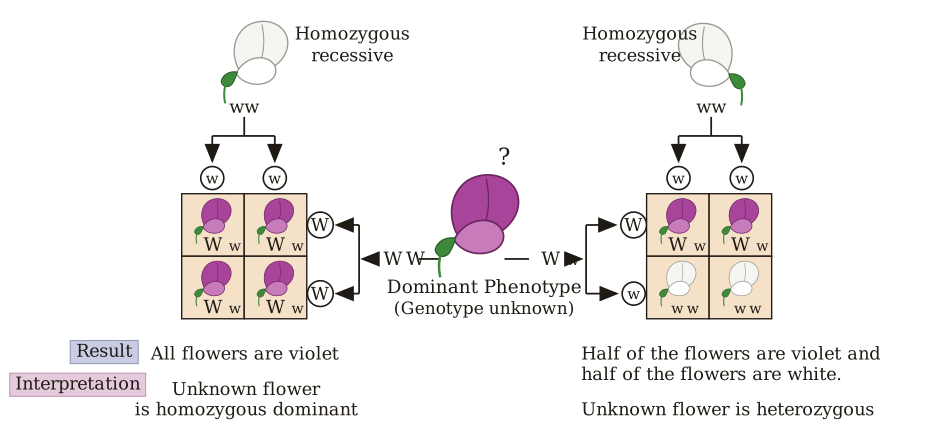
If the individual being tested is truly homozygous dominant, every one of its gametes carries the dominant allele, so all offspring of the test cross show the dominant phenotype. If it is instead heterozygous, half its gametes carry the dominant allele and half the recessive, so the offspring split 1:1 between dominant and recessive phenotypes. The chapter illustrates this with flower colour in pea: an unknown violet-flowered plant crossed with a white-flowered (homozygous recessive) plant gives either all-violet offspring (confirming the unknown plant is homozygous, RR) or a 1:1 violet:white split (confirming it is heterozygous, Rr). The graphic representation of this test cross (Fig. 3.1) shows the recessive parent being crossed to find out the unknown genotype.
Drawn by us to help you understand the concept clearly, and verified to make sure it's accurate. For exams, practice from your textbook's own diagram.
What this figure shows. Shows an unknown-genotype violet-flowered pea plant with dominant phenotype crossed against a homozygous recessive white-flowered plant to reveal its genotype: if the plant is truly homozygous dominant (RR) every offspring is violet, but if it is heterozygous (Rr) the offspring split violet:white in a 1:1 ratio, which is how the test distinguishes th …
…