Biology · Ch 3 — Inheritance and Variation
Genetic Terminology
Genetic Terminology
Before working through Mendel's laws it helps to fix the vocabulary geneticists use. The book defines the following terms, in this order:
Character : a specific feature of an organism, e.g. the height of the stem of a plant.
Trait : an inherited character and its detectable variant, e.g. tall or dwarf.
Factor : the unit of heredity: a particle present in the organism that is responsible for the inheritance and expression of a character. A factor passes from one generation to the next through the gametes and determines a genetic (biological) character.
Gene : the particular segment of DNA that is responsible for the inheritance and expression of a character; the modern name for Mendel's factor.
Alleles or Allelomorphs : the two or more alternative forms of a given gene (factor); they occupy identical loci (positions) on homologous chromosomes. 'Allele' is the short form of allelomorph.
Dominant : the allele that expresses its trait even in the presence of an alternative allele, i.e. in the heterozygous condition; put another way, the allele that expresses in F1 and masks its partner.
Recessive : the allele that is not expressed in the presence of an alternative allele (in the heterozygous condition); it expresses only when paired with another identical allele, so it does not show in the F1 hybrid.
Phenotype : the external appearance of an individual for a trait; it is observable and is determined by the combination of alleles. In pea, tall and dwarf are the two phenotypes for stem height (tall from TT or Tt, dwarf from tt).
Genotype : the genetic constitution (make-up) of an organism for a particular trait or set of traits. A tall pea plant can have the genotype TT or Tt; a dwarf plant has tt.
Homozygous (pure) : an individual with identical alleles for a trait. It breeds true and produces only one type of gamete, e.g. tall with TT and dwarf with tt.
Heterozygous : an individual with contrasting alleles for a trait. It does not breed true and produces two types of gametes, e.g. the F1 hybrid Tt. A heterozygous individual is also called a hybrid.
Pure line : an individual or population that is homozygous (true breeding) for one or more traits; it descends from a single homozygous parent by self-fertilisation.
Monohybrid : an individual heterozygous for one trait, produced from a cross between two pure parents differing in a single pair of contrasting characters, e.g. the hybrid tall from pure tall x pure dwarf.
F1 generation : the first filial generation: all the offspring of the parental cross between pure parents with contrasting characters.
F2 generation : the second filial generation: the progeny produced by selfing (inbreeding) the F1 individuals, e.g. from Tt x Tt.
Punnett square / checker board : a probability table showing every permutation and combination of fertilisation between the gametes of the two mating types; in short, a diagram of a cross used to predict its progeny.
Homologous chromosomes : the morphologically, genetically and structurally essentially identical chromosomes present in a diploid cell; they synapse during meiosis.
Back cross : a cross of F1 progeny with either of the parents, e.g. F1 tall x pure tall or F1 tall x pure dwarf (Tt x TT / tt).
Test cross : a cross of F1 progeny with the homozygous recessive parent (Tt x tt); it is used to test whether the hybrid is homozygous or heterozygous and is a kind of back cross.
Phenotypic ratio : the ratio of offspring in F2 and later generations by physical appearance, e.g. 3 tall : 1 dwarf in a monohybrid cross.
Genotypic ratio : the ratio of offspring in F2 and later generations by genetic make-up, e.g. 1 TT : 2 Tt : 1 tt in a monohybrid cross.
Monohybrid cross : a cross between parents differing in only one heritable trait, e.g. pure tall x pure dwarf. Mendel performed such crosses between pea plants with one pair of contrasting characters. …
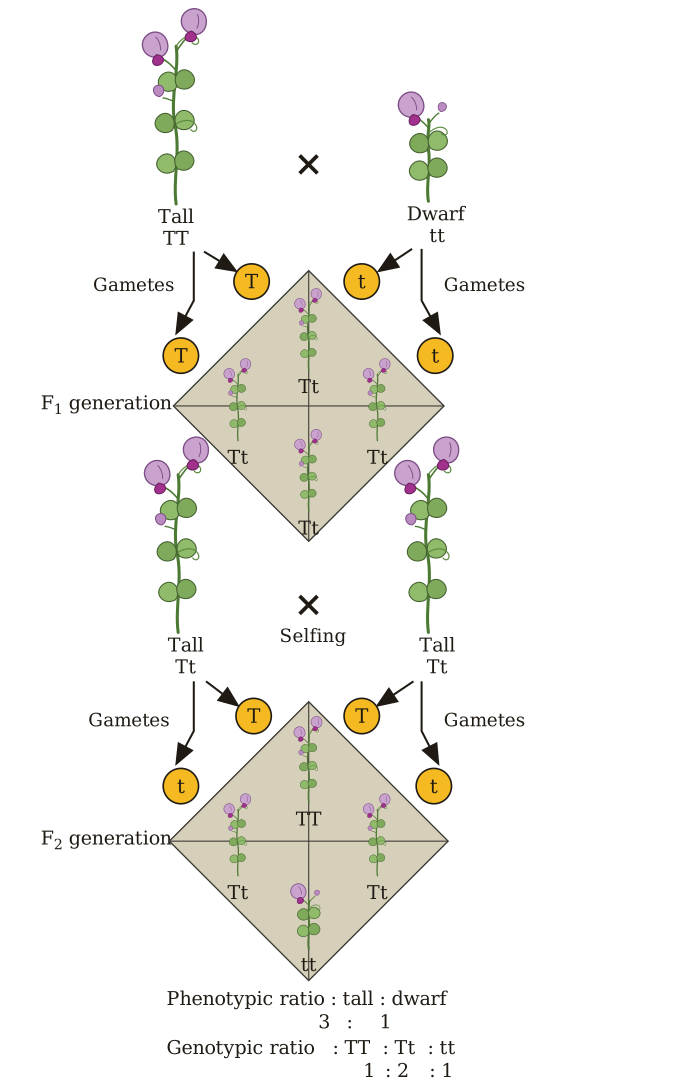
Parents: Tall (TT) x Dwarf (tt). Gametes: T from tall parent, t from dwarf parent. F1: all Tt (Tall). Selfing F1 x F1 (Tt x Tt) gives gametes T and t from each parent. F2 Punnett square: TT, Tt, Tt, tt -> genotypic ratio 1 TT : 2 Tt …
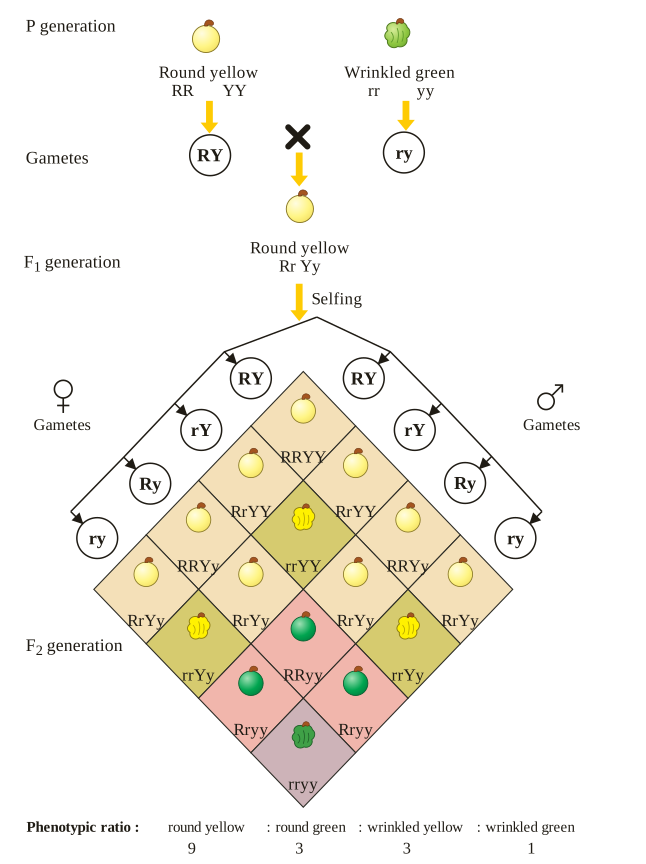
Parents: Round-Yellow (RRYY) x Wrinkled-Green (rryy). Gametes: RY from one parent, ry from the other. F1: RrYy (Round, Yellow). Selfing F1 x F1 (RrYy x RrYy): each F1 forms four gamete types RY, Ry, rY, ry in equal proportion, which combine a …