Biology · Ch 3 — Inheritance and Variation
Genetic Disorders
Genetic Disorders
Genetic disorders fall into two broad categories. Mendelian disorders arise from alteration or mutation of a single gene and follow the classic dominant/recessive inheritance patterns covered earlier in this chapter — examples include thalassemia, sickle-cell anaemia, colour blindness, haemophilia and phenylketonuria. Chromosomal disorders instead arise from the absence, excess, or abnormal arrangement of one or more entire chromosomes — examples include Down's syndrome, Turner's syndrome and Klinefelter's syndrome.
Thalassemia : Thalassemia is an autosomal recessive inherited disorder affecting haemoglobin, which is normally built from four polypeptide chains — two alpha (α) chains, whose synthesis is controlled by two closely linked genes (HBA1 and HBA2) on chromosome 16, and two beta (β) chains, controlled by a single gene (HBB) on chromosome 11. Depending on which chain's gene is deleted or mutated, the condition is classed as alpha-thalassemia or beta-thalassemia; affected individuals show anaemia, pale-yellow skin, abnormal red-blood-cell size and shape, slow growth, dark urine, and typically require regular blood transfusions. Thalassemia differs from sickle-cell anaemia in kind: thalassemia is a quantitative problem (too little of a normal globin chain is made), while sickle-cell anaemia is a qualitative problem (an abnormal, incorrectly functioning globin is made).
Down's Syndrome (21st trisomy) : Among the chromosomal disorders, Down's syndrome (also called 21st trisomy) is named after physician John Langdon Down, who first described it in 1866. It results from an extra copy of chromosome 21 — three copies instead of the normal homologous pair — giving affected individuals 47 chromosomes instead of the usual 46; this trisomy arises from non-disjunction (failure of chromosomes to separate properly) during gamete formation, a risk that rises distinctly in mothers over 45. Affected individuals typically show mild-to-moderate mental retardation, poor skeletal development, and characteristic facial features including a small head, small ears and mouth, a flat, rounded face with a flat nose, an open mouth with a protruding tongue, upward-and-outward slanting eyes with internal epicanthal folds, and broad, flat hands with a single palmar crease and stubby fingers.
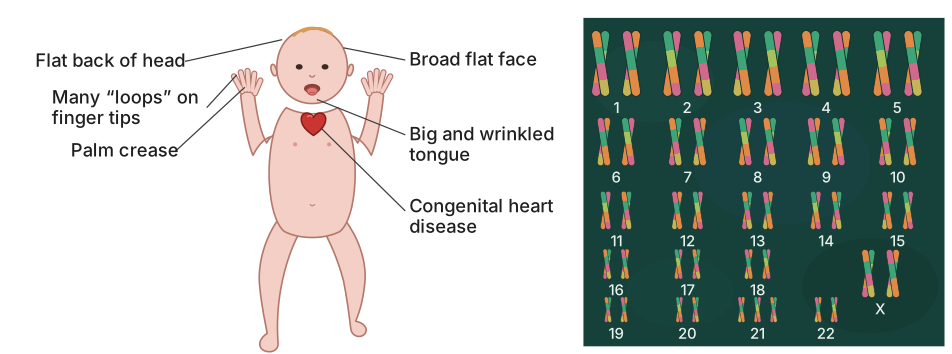
Drawn by us to help you understand the concept clearly, and verified to make sure it's accurate. For exams, practice from your textbook's own diagram.
What this figure shows. Shows a child with Down's syndrome alongside the karyotype that explains it: an extra copy of chromosome 21 (three copies instead of the normal homologous pair) giving 47 chromosomes in total, arising from non-disjunction during gamete formation, a risk that rises distinctly in mothers over 45; the syndrome's facial and developmental features are described alongside …
Turner's Syndrome (X monosomy / XO females) : Turner's syndrome (X-monosomy, genotype 44 + XO) is a sex-chromosomal disorder caused by non-disjunction during egg formation; affected individuals are phenotypically female, with short stature, a webbed neck, a low posterior hairline, a broad shield-shaped chest, poorly developed ovaries and breasts, and generally low intelligence. …