Biology · Ch 3 — Inheritance and Variation
Chromosomal Theory of Inheritance
Chromosomal Theory of Inheritance
Mendel published his findings in 1866, but for decades the work went almost unnoticed, partly because scientific communication was slow in that era and partly because his mathematical, statistical approach to a biological question was unfamiliar and unwelcome to contemporary biologists, who were also unconvinced by his claim that hereditary factors stayed discrete rather than blending. Mendel himself had no way to say where in the cell his 'factors' physically resided.
Mendel's work was independently rediscovered in 1900 by three scientists — Hugo de Vries, Correns and von Tschermak — around the same time that improved microscopy was finally allowing biologists to directly observe cell division and chromosome structure. This set the stage for Walter Sutton and Theodor Boveri, who in 1903 studied the behaviour of chromosomes during meiosis and noticed it ran exactly parallel to the behaviour Mendel had inferred for his hereditary factors: chromosomes exist in pairs in somatic cells; during gamete formation these homologous pairs come together, then segregate and assort independently, so that each gamete ends up with just one chromosome from each original pair; and fertilisation, by fusing a haploid sperm with a haploid egg, restores the full diploid chromosome number characteristic of the species.
On this basis, Sutton and Boveri put forward the Chromosomal Theory of Inheritance, which identifies chromosomes — not some abstract, disembodied factor — as the actual physical carriers of hereditary material. Every hereditary trait passed from parent to offspring is therefore carried in the chromosomes housed in the sperm and egg nuclei, making the gametes the essential physical link between one generation and the next.
Activity …
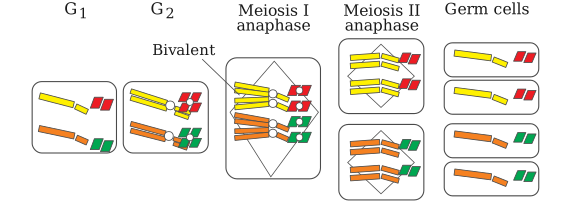
Drawn by us to help you understand the concept clearly, and verified to make sure it's accurate. For exams, practice from your textbook's own diagram.
Diagram for the Activity above: the homologous chromosomes carrying A and a pair, segregate in meiosis I and their chromatids separate in meiosis II, mirroring the se …