Biology · Ch 3 — Inheritance and Variation
Sex Determination
Sex Determination
Sex determination is the mechanism that establishes the sexual phenotype of an organism. Some species carry both male and female reproductive organs in the same individual and are described as bisexual, hermaphrodite or monoecious; species like humans, where each individual has only one set of reproductive organs, are dioecious (unisexual). The physical basis of chromosomal sex determination was first hinted at in 1891, when the German biologist Henking, studying sperm formation in the squash bug (Anasa tristis), noticed that only half of the sperm received a particular unpaired structure he called the 'x-body'; later work identified this structure as a true chromosome and renamed it the X-chromosome.
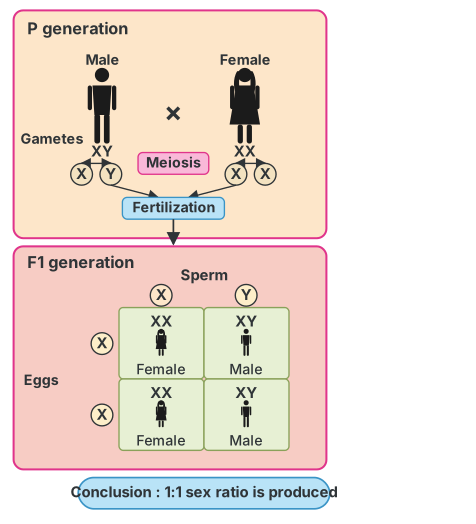
a. Sex Determination in human beings : In humans, sex determination follows the XX-XY mechanism. Each somatic cell carries 46 chromosomes (23 pairs): 22 pairs of autosomes plus one pair of sex chromosomes. Females carry two structurally similar (homomorphic) X chromosomes (44 autosomes + XX), while males carry one X and one structurally different (heteromorphic) Y chromosome (44 autosomes + XY). During spermatogenesis, a male's diploid germ cells produce two types of sperm in equal numbers — half carrying an X chromosome, half carrying a Y — making the male heterogametic. During oogenesis, a female's diploid germ cells produce only one type of egg, always carrying an X chromosome, making the female homogametic. If an X-bearing sperm fertilises the egg, the resulting XX zygote develops into a female; if a Y-bearing sperm fertilises the egg, the resulting XY zygote develops into a male. Since it is the father's sperm — not anything about the mother — that supplies the deciding chromosome, it is the father who determines the sex of the child; blaming mothers for the sex of their children, as sometimes happens culturally, has no biological basis.
Drawn by us to help you understand the concept clearly, and verified to make sure it's accurate. For exams, practice from your textbook's own diagram.
What this figure shows. Shows the human chromosomal mechanism: fathers are heterogametic, producing X-bearing and Y-bearing sperm in equal numbers, while mothers are homogametic, producing only X-bearing eggs, so a Y-bearing sperm fertilising the egg gives an XY (male) zygote and an X-bearing sperm gives an XX (female) zygote — meaning the father's sperm decides the child …
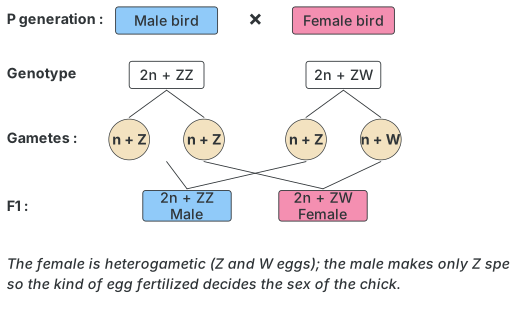
b. Sex Determination in birds : Birds use the reverse arrangement, the ZW-ZZ mechanism: here it is the female that is heterogametic, producing two kinds of eggs in equal numbers (Z-bearing and W-bearing), while the male is homogametic, producing only Z-bearing sperm — so in birds it is the type of egg, not the sperm, that decides the offspring's sex; the cross still averages out to a 1:1 sex ratio overall.
Drawn by us to help you understand the concept clearly, and verified to make sure it's accurate. For exams, practice from your textbook's own diagram.
What this figure shows. Shows the reversed pattern found in birds: here it is the female that is heterogametic, producing Z-bearing and W-bearing eggs in equal numbers, while the male is homogametic and produces only Z-bearing sperm, so the egg (not the sperm) determines the offspring's sex, and …
Something Interesting
In Bonellia viridis, environmental factors determine the sex of the individual: the sex of this marine worm depends on where the Bonellia larva settles. The female has a body about 10 cm long with a proboscis that can extend over a metre. A larva that settles on the sea floor becomes a female; a larva that lands on a female's proboscis and enters her mouth migrates into her uterus and differentiates into a male, which lives as a parasite in the uterus of the female, fertilising her eggs. …
Drawn by us to help you understand the concept clearly, and verified to make sure it's accurate. For exams, practice from your textbook's own diagram.
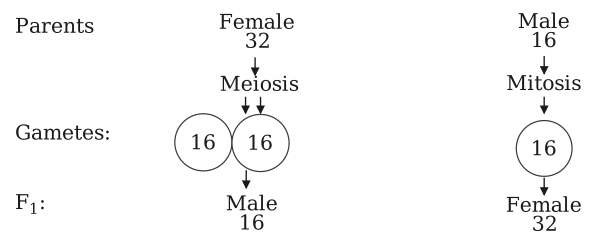
What this figure shows. Shows the haplo-diploid system of the honey bee: a fertilised (diploid, 2n=32) egg always develops into a female — either a fertile queen or a sterile worker depending on whether it was fed royal jelly — while an unfertilised (haploid, n=16) egg develops without fertilis …