Biology · Ch 3 — Inheritance and Variation
Linkage and Crossing Over
Linkage and Crossing Over
Linkage : Linkage describes the tendency of genes that sit close together on the same chromosome to be inherited together, rather than assorting independently as Mendel's third law predicts for genes on different chromosomes. Because chromosomes physically carry hereditary material, genes riding on the same chromosome tend to travel as a package unless something actively separates them; such genes are called linked genes, and this phenomenon of joint inheritance is linkage. It was first discovered in plants by Bateson and Punnett, and in animals by T. H. Morgan. Linkage is of two kinds, complete and incomplete:
I. Complete linkage : Complete linkage occurs when genes are so closely spaced on the chromosome that no crossing over separates them, so the parental combinations of traits pass to offspring intact — seen, for instance, in the genes on the X chromosome of male Drosophila.
II. Incomplete linkage : Incomplete linkage occurs when genes lie farther apart on the same chromosome, giving crossing over a real chance to separate them during meiosis and produce new (recombinant) trait combinations in the offspring — as with the genes controlling grain colour and shape in maize (Zea mays).
Linkage Groups : All the linked genes located on one particular chromosome together form a linkage group, and the number of linkage groups in a species equals its haploid chromosome number — Drosophila melanogaster, with 4 pairs of chromosomes, has 4 linkage groups, while garden pea, with 7 pairs, has 7.
Sex-linkage : A special case of linkage applies to genes located on the sex chromosomes, called sex-linkage, which comes in X-linked, Y-linked and XY-linked forms. Sex linkage is of two kinds:
a. Complete sex linkage : Complete sex linkage occurs for genes on the non-homologous regions of the X or Y chromosome, since no crossing over happens there, so these genes (e.g., the X-linked disorders haemophilia, red-green colour blindness, myopia and ichthyosis, or the Y-linked hypertrichosis and H-Y antigen gene) always travel together with their chromosome.
b. Incomplete sex linkage : Incomplete sex linkage applies to genes on the small homologous region shared by X and Y, where crossing over does occur (e.g., total colour blindness, nephritis, retinitis pigmentosa), so these genes are not always inherited together.
Crossing Over : Crossing over itself is the physical process, occurring during the pachytene stage of prophase I of meiosis, in which corresponding DNA segments are exchanged between non-sister chromatids of homologous chromosomes, generating new gene combinations (recombinations) not present in either parent — the term itself was coined by Morgan. Its mechanism runs through four sequential steps: synapsis, tetrad formation, crossing over itself, and terminalisation. Crossing over is essentially universal across sexually reproducing organisms (with the notable exception of male Drosophila), and it matters evolutionarily because it constantly generates fresh combinations of alleles, increasing the raw variation natural selection can act on. You have already studied the four steps in the chapter on cell division in Class XI.
Can you tell?
- What are allosomes?
- Compare X and Y chromosomes.
- In which region of the chromosomes does crossing over take place? …
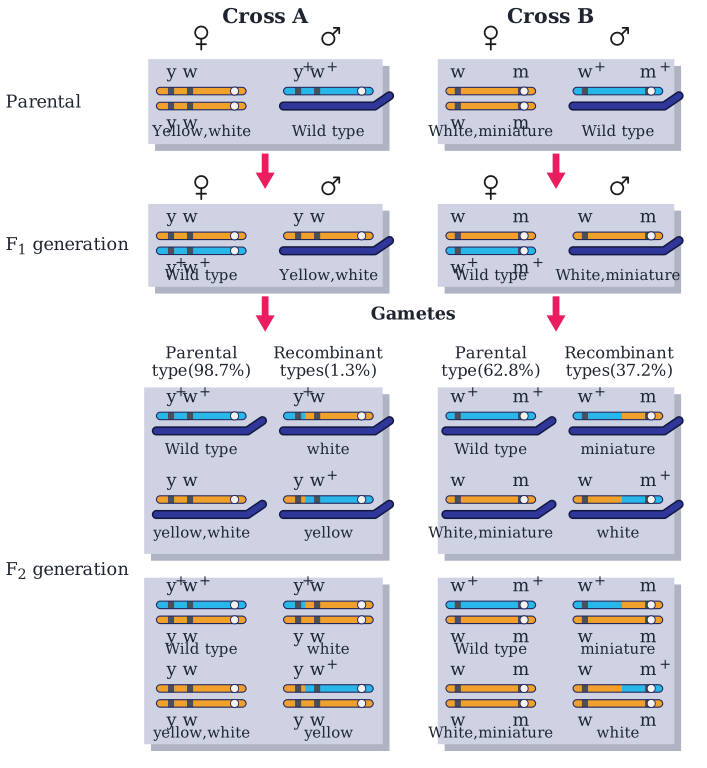
Drawn by us to help you understand the concept clearly, and verified to make sure it's accurate. For exams, practice from your textbook's own diagram.
Cross I (yellow body y, white eye w): parental type about 98.7%, recombinant types about 1.3%. Cross II (white eye w, miniature wing m): parental type about 62.8%, …