Biology · Ch 3 — Inheritance and Variation
Sex Linked Inheritance
Sex Linked Inheritance
Genes located on the non-homologous regions of the sex chromosomes are called sex-linked genes, the traits they control are sex-linked traits, and their transmission from parent to offspring is sex-linked inheritance. There are two types of sex-linked genes: X-linked genes and Y-linked genes.
a. X-linked (sex linked) genes : The X-linked genes are located on the non-homologous region of the X chromosome and have no corresponding alleles on the Y chromosome. The key asymmetry driving X-linked inheritance is that females carry two X chromosomes while males carry only one. In a female, a single recessive X-linked allele is masked by the dominant allele on her other X chromosome, so she is a physically normal, unaffected carrier; only a female with two copies of the recessive allele shows the disorder. In a male, there is no second X chromosome to mask a recessive allele — whatever allele is present on his single X is expressed outright — so X-linked recessive disorders appear far more frequently in males than in females. Classic examples include colour blindness, haemophilia, night blindness and muscular dystrophy.
b. Y-linked (Holandric) genes : Genes located on the non-homologous region of the Y chromosome are Y-linked genes. They are inherited directly from male to male: in man the Y-linked gene for hypertrichosis (excessive hair on the pinna of the ear) is transmitted directly from father to son.
Internet my friend
Collect information on Ishihara's test for colour blindness.
Colour blindness : Colour blindness is an X-linked recessive disorder in which the person cannot distinguish between red and green, both of which appear grey. It is caused by the recessive X-linked gene (Xc), which prevents the formation of the colour-sensitive cone cells in the retina; the dominant gene (XC) is needed for their formation. Homozygous recessive females (XcXc) and hemizygous recessive males (XcY) are colour blind, so colour-blind women are much rarer than colour-blind men. The genotypes are:
| Sex | Normal | Colourblind | Carrier |
|---|---|---|---|
| Male | XCY | XcY | - |
| Female | XCXC | XcXc | XCXc |
The inheritance of colour blindness can be studied in the following two types of marriages:
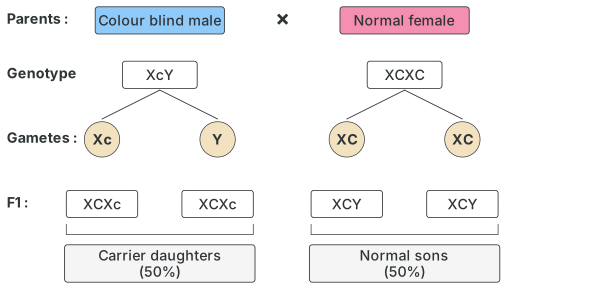
- Marriage between a colour-blind male and a normal female produces normal-visioned sons and daughters in F1; the sons have normal vision but every daughter is a carrier (Fig. 3.10).
Drawn by us to help you understand the concept clearly, and verified to make sure it's accurate. For exams, practice from your textbook's own diagram.
Fig. 3.10 : Sex linked inheritance (colour blindness), marriage 1: colour-blind male x normal female -> carrier daughters (50%) …
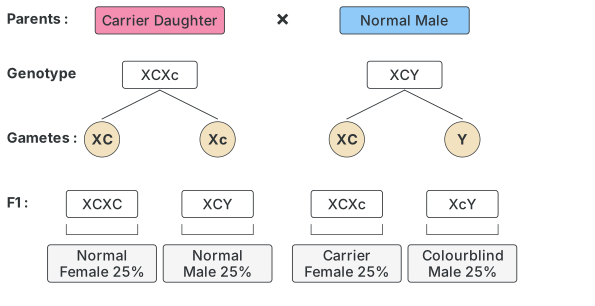
- Marriage between a carrier female (such a daughter) and a normal male produces daughters with normal vision, half of whom are carriers, while half the sons are normal and the other half colour blind (Fig. 3.11).
Drawn by us to help you understand the concept clearly, and verified to make sure it's accurate. For exams, practice from your textbook's own diagram.
Fig. 3.11 : Sex linked inheritance (colour blindness), marriage 2: carrier daughter x normal male -> 25% normal female, 25% normal male, 25% carrier fem …
From these examples it is clear that the X-linked recessive gene for colour blindness passes from a colour-blind father to his grandson through his daughter. This zig-zag pattern is called criss-cross inheritance.
Haemophilia (Bleeder's disease) : Haemophilia is an X-linked recessive disorder in which the blood fails to clot or clots very slowly. The genes for normal clotting are dominant over the recessive genes for haemophilia; a person with the recessive gene is deficient in clotting factor VIII or IX, so even minor injuries cause continuous bleeding, hence the name bleeder's disease. The recessive gene lies on the non-homologous region of the X chromosome; as there is no corresponding allele on the Y chromosome to suppress it, men suffer from the disease, while a woman suffers only when both her X chromosomes carry the recessive allele. The genotypes are:
| Sex | Normal | Haemophilic | Carrier |
|---|---|---|---|
| Male | XHY | XhY | - |
| Female | XHXH | XhXh | XHXh |
Like colour blindness, haemophilia also shows criss-cross inheritance. Its inheritance can be studied with the same two marriages:
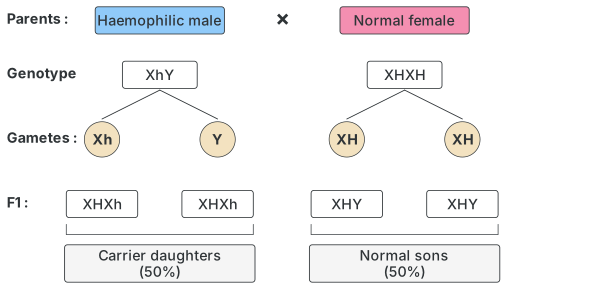
- Marriage between a haemophilic male and a normal female gives carrier daughters (50%) and normal sons (50%) (Fig. 3.12).
Drawn by us to help you understand the concept clearly, and verified to make sure it's accurate. For exams, practice from your textbook's own diagram.
Fig. 3.12 : Sex linked inheritance (haemophilia), marriage 1: haemophilic male x normal female -> carrier daughters (50%) …
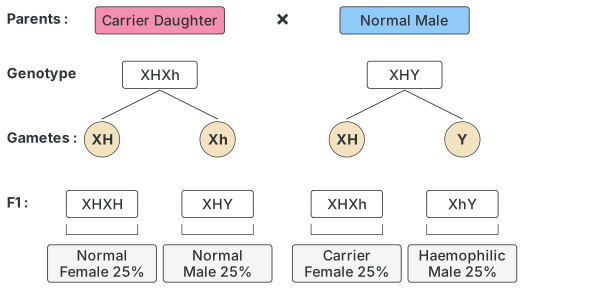
…
Drawn by us to help you understand the concept clearly, and verified to make sure it's accurate. For exams, practice from your textbook's own diagram.
Fig. 3.13 : Sex linked inheritance (haemophilia), marriage 2: carrier daughter x normal male -> 25% normal female, 25% normal male, 25% carrier fem …