Biology · Ch 6 — Plant Water Relation
Lenticular Transpiration
Lenticular Transpiration
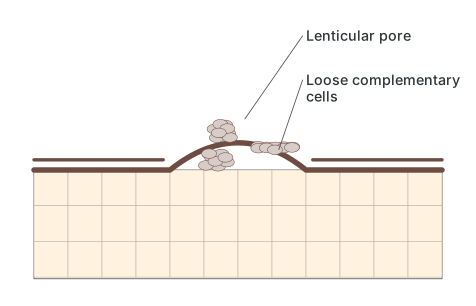
ii. Lenticular transpiration: Lenticular transpiration is water loss occurring through lenticels — small, slightly raised patches on the bark made up of loosely arranged complementary cells with unusually large intercellular spaces between them. Lenticels are found embedded in the periderm (bark) of secondarily thickened woody stems and roots of dicotyledonous plants, and also in the skin (pericarp) of woody fruits, but they are entirely absent from leaves. …
Drawn by us to help you understand the concept clearly, and verified to make sure it's accurate. For exams, practice from your textbook's own diagram.
What this figure shows. This diagram shows a lenticel in cross-section as a small breach in the otherwise continuous, corky bark tissue. It labels the lenticular pore at the surface and, beneath it, the loosely arranged complementary cells that fill the lenticel, drawn with visibly large intercellular air spaces between them compared to the tightly packed cells of the surrounding bark. The loose packing is what the figure is illustrating: it is precisely these enlarged air gaps between complementary cells that let water vapour and gase …