Biology · Ch 6 — Plant Water Relation
Osmosis
Osmosis
c. Osmosis : Osmosis is the third and final step of water absorption by a root hair — the process by which water actually crosses the selectively permeable plasma membrane and enters the living cytoplasm. Formally, osmosis is a special case of diffusion: it is specifically the diffusion of a solvent (here, water) through a semipermeable membrane.
The cytoplasm of a root hair cell contains dissolved minerals, sugars and other solutes, making the solution inside the cell more concentrated ('stronger') than the water immediately outside it ('weaker'). Because solvent always tends to move from a weaker (more dilute) solution toward a stronger (more concentrated) one across a semipermeable membrane, water moves from the wall/membrane interface into the cytoplasm — completing the three-step absorption sequence of imbibition, diffusion and osmosis (Fig. 6.2).
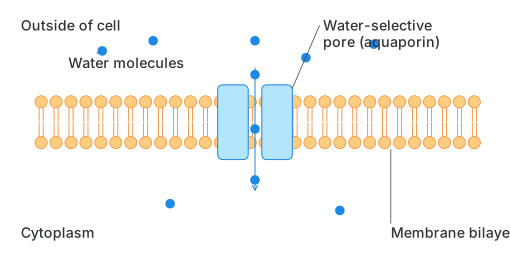
Drawn by us to help you understand the concept clearly, and verified to make sure it's accurate. For exams, practice from your textbook's own diagram.
What this figure shows. This diagram zooms into a small patch of the plasma membrane bilayer separating the outside of a root cell from its cytoplasm. It shows individual water molecules approaching the membrane from outside and passing through it via a water-selective channel protein embedded in the bilayer, labelled as an aquaporin pore. The figure is used to illustrate that although water can slowly cross the lipid bilayer directly, the bulk of osmotic water movement into the cell is channelled through these dedicated aquaporin pores, which speed up water entry without requiring an …
With respect to concentration and osmotic migration, three types of solutions are recognised:
i. A hypotonic solution has a low osmotic concentration (a weak solution, or in effect a 'strong' solvent).
ii. A hypertonic solution has a high osmotic concentration (a strong solution, or a 'weak' solvent).
iii. An isotonic solution has exactly the same concentration as the solution being compared to it, so there is neither net gain nor net loss of water between them.
Osmosis is of two types:
Exosmosis : is the outward diffusion of solvent, out of the cell; it causes the cell to become flaccid (lose turgor).
Endosmosis : it is the inward diffusion of solvent, into the cell; it causes the cell to become turgid, as its cytoplasm swells against the wall.
As a cell becomes turgid through endosmosis, its turgor pressure (T.P.) — the pressure that the swollen cell sap exerts outward against the cell membrane and wall — rises. In a fully turgid cell, DPD falls to zero. Because the cell wall is rigid, it pushes back against the cell sap with an equal and opposite force, called wall pressure (W.P.); in a fully turgid cell, T.P. and W.P. are numerically equal but act in opposite directions.
Osmotic pressure (O. P.) : Osmotic pressure is the pressure that osmosis generates, and it can be defined more precisely as the pressure that would have to be applied to a solution, from the outside, to just stop solvent from entering it across a semipermeable membrane. Putting these three quantities together gives the working relationship the textbook uses throughout the chapter:
D.P.D. = O.P. - T.P.
and, since T.P. = W.P.,
D.P.D. = O.P. - W.P.
From this relationship, two useful special cases follow: in a fully flaccid cell, T.P. is zero, so DPD = OP; in a fully turgid cell, DPD is zero, so TP = OP.
Facilitated diffusion …