Biology · Ch 6 — Plant Water Relation
Root Pressure Theory (Vital Theory)
Root Pressure Theory (Vital Theory)
a. Root Pressure Theory (Vital Theory) : The root pressure theory (also called the vital theory, because it credits the phenomenon to the living activity of root cells) was first proposed by J. Priestley. According to this theory, translocation of water is driven by the continuous metabolic activity of the living cells of the root.
A simple but compelling piece of evidence for root pressure is exudation: if the stem of a potted plant is cut off with a sharp knife just a few inches above the soil, xylem sap can be seen oozing or flowing out from the cut stump on its own, with no pump or external force involved — clear proof that the root system is actively pushing sap upward under its own pressure. This experimental setup can be made quantitative by connecting the cut stump to a manometer, which measures the exudation pressure directly (this is what the accompanying figure in section 6.9a illustrates).
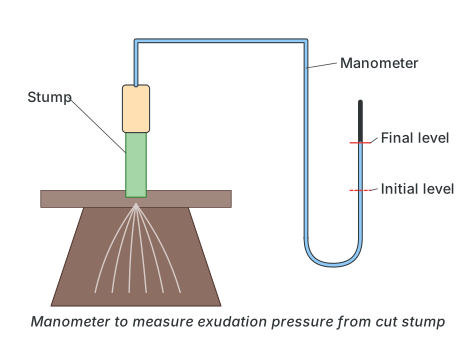
Drawn by us to help you understand the concept clearly, and verified to make sure it's accurate. For exams, practice from your textbook's own diagram.
What this figure shows. The diagram shows a potted plant whose stem has been cut off a short distance above the soil, with the cut stump connected by tubing to a manometer. As the intact root system continues to push xylem sap upward, the rising sap is forced into the manometer tube, and the diagram marks an initial fluid level and a higher final fluid level to show the exudation pressure being measured. This classic set-up is used as direct experimental evidence that living root cells generate a real, measurable positive pressure even in the comp …
Because root water absorption is a continuous, ongoing process, a hydrostatic pressure is steadily built up in the living cells of the root cortex; it is this pressure — named root pressure by S. Hales — that forces water, together with its dissolved minerals, from the pericycle into the xylem and then continues to push it upward against gravity. Root pressure appears to be largely an osmotic phenomenon, and building it up is an active process on the part of the root's living cells. Typical measured values of root pressure are only about +1 to +2 bars, but that modest pressure is nonetheless enough, by itself, to push a column of water up to a height of 10 to 20 metres. Factors such as soil oxygen availability, soil moisture, soil temperature and salt content all influence how much root pressure a plant can generate.
Objections / limitations of root pressure theory: Although ascent of sap takes place due to root pressure, certain objections are raised, such as:
i. It cannot account for water rising in plants taller than about 20 metres, since the largest measured root pressures are far too small to push a column that high.
ii. Ascent of sap can still occur even in plants with no functioning root system at all, which root pressure alone cannot explain.
iii. In tall gymnosperm trees, measured root pressure is almost negligible (close to zero), yet water still rises to great heights in these trees.
iv. In actively transpiring plants, essentially no root pressure develops at all — precisely when the plant most needs to move large volumes of water upward. …