Biology · Ch 6 — Plant Water Relation
Transpiration and Guttation
Transpiration and Guttation
A plant absorbs water constantly and continuously, but it puts hardly 5% of everything it takes in to actual use, for cell expansion and growth. The remaining 95% becomes surplus, and this surplus water is lost to the atmosphere through the plant's aerial parts. Of that surplus, only about 1% is lost in liquid form, while the remaining 99% is lost as vapour.
The loss of water in liquid form is called guttation, and it takes place through specialised structures called water stomata, or hydathodes, typically found along the margins or tips of leaves. Guttation is most noticeable in low-transpiration conditions — such as humid nights or early mornings — when root pressure continues pushing water up into the leaf even though the stomata that normally allow vapour loss are largely closed; with nowhere else for the excess pressure to go, water is forced out as visible liquid droplets through the hydathodes instead. Guttation fluid is not the same as dew: dew condenses onto the leaf surface from atmospheric moisture, whereas guttation fluid is pushed out from inside the plant's own vascular tissue by active root pressure. …
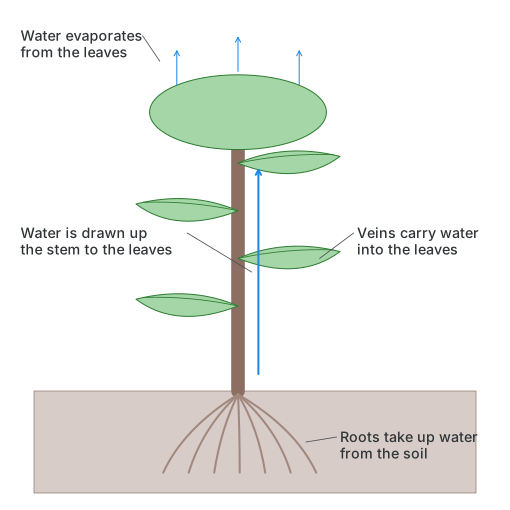
Drawn by us to help you understand the concept clearly, and verified to make sure it's accurate. For exams, practice from your textbook's own diagram.
What this figure shows. This whole-plant diagram traces the entire water pathway in one continuous picture: roots taking up water from the soil at the base, the stem drawing that water upward, veins carrying it out into the leaf blade, and finally water evaporating from the leaf surface into the surrounding air (shown as rising wavy arrows above the leaves). It visually links root absorption, ascent through the stem, and evaporative water loss at the leaf into a single connected transpiration stream, rather …