Biology · Ch 6 — Plant Water Relation
Path of Water Across the Root
Path of Water Across the Root
Once water has entered a root hair cell through the imbibition–diffusion–osmosis sequence, it still has to cross the width of the root — through the cortex, past the endodermis, and into the pericycle — before it can enter the xylem and begin its long ascent. This inward, cell-to-cell journey happens step by step, driven by a continuous chain of suction-pressure (DPD) differences: as the root-hair cell absorbs water and becomes turgid, its own DPD falls, but the next cortical cell inward still has a higher DPD (because its osmotic pressure is greater), so it draws water from the now-turgid root hair, itself becoming turgid in turn — while the root hair, now relatively flaccid again, goes back to absorbing more water from the soil. This same relay repeats across one cortical cell after another, so that a gradient of suction pressure runs continuously from the epiblema at the outer edge of the root to the innermost cortex, moving water rapidly inward through the loosely packed, water-permeable cells of the cortex. In monocot roots this includes specialised thin-walled passage cells of the endodermis, and the water finally reaches the pericycle, which lies in close contact with the protoxylem, allowing water to pass directly into the xylem.
The pathway of water across the root essentially occurs in two ways, apoplast and symplast:
| Pathways | |
|---|---|
| Apoplast | Symplast |
| Vacuolar · Transmembrane |
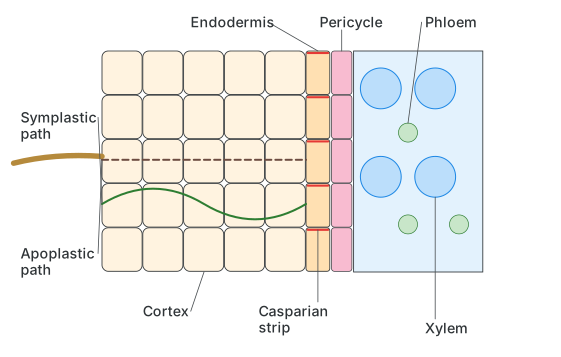
Apoplast pathway : Here water moves through the non-living parts of the tissue — the cell walls and the intercellular spaces between cortical cells — rather than through the interior of any living cell. This pathway can carry water as far as the endodermis, but no further in the normal course, because the endodermal cell walls contain a band of waxy, water-impermeable material called the Casparian strip, which blocks the apoplast route and forces water to cross into the symplast (living cytoplasm) in order to continue toward the vascular tissue.
The apoplastic route
The apoplastic (non-living) pathway provides a route toward the vascular stele through free spaces and cell walls of the epidermis and cortex. An additional apoplastic route that allows direct access to the xylem and phloem is along the margins of secondary roots. Secondary roots develop from the pericycle, a cell layer just inside the endodermis. The endodermis is characterised by the Casparian strip, a suberised layer that forces water to move in the symplast in order to enter the vascular system. Since secondary roots grow through the endodermis, a direct pathway to the xylem and phloem is available that bypasses the Casparian strip and allows water to enter the vascular system without moving into the symplast (living tissue). …
Drawn by us to help you understand the concept clearly, and verified to make sure it's accurate. For exams, practice from your textbook's own diagram.
What this figure shows. This diagram shows a radial cross-section through a young root, from the outer cortex on the left, through the endodermis, and into the central stele containing the pericycle, xylem and phloem. Two alternative routes for water are traced with different line styles: the apoplastic path, which runs through the cell walls and intercellular spaces of the cortex and stops at the endodermis because of a waxy Casparian strip embedded in the endodermal cell walls, and the symplastic path, which runs from cell to cell through the living cytoplasm and plasmodesmata, bypassing the Casparian strip and continuing on into the stele. The figure makes clear that water travelling by the apoplast route is forced to switch into the symplast at the endodermis, so that all water entering the xylem has passed through at lea …