Biology · Ch 6 — Plant Water Relation
Transport of Food
Transport of Food
Every part of a plant needs a continuous supply of food (the products of photosynthesis, or photosynthate) to support its nutrition and growth. In more complex, higher plants there is a clear division of labour between tissues: chloroplasts, and therefore the ability to make food by photosynthesis, are confined to the green cells of the leaves, while non-green organs such as the root and much of the stem cannot make their own food and must instead receive it from the leaves. The textbook names the tissue or organ where food is actually synthesised the source, and the tissue or organ where that food is used up or stored the sink; food must physically travel from source to sink through the plant's vascular tissue.
Path of translocation : The channel for this movement is the phloem — specifically its sieve tubes, which are structurally well suited, alongside their associated companion cells, to carrying dissolved food over long, longitudinal (vertical) distances. Several independent lines of evidence establish that phloem, not xylem, is responsible for this longitudinal, largely downward flow of food: ringing experiments (removing a strip of bark and phloem interrupts food movement while leaving water transport intact), the structure and distribution of phloem tissue itself, chemical analysis of collected phloem sap, and tracer studies using the radioactive isotope carbon-14 to follow labelled sugar as it moves through the plant.
Drawn by us to help you understand the concept clearly, and verified to make sure it's accurate. For exams, practice from your textbook's own diagram.
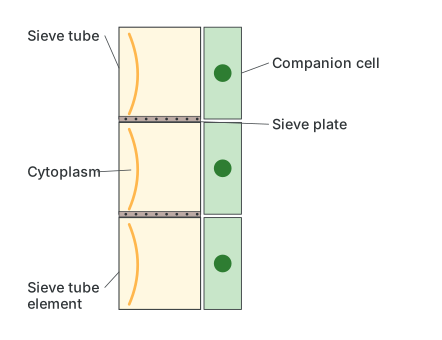
What this figure shows. This diagram shows a short stretch of phloem tissue in longitudinal section, with two sieve-tube elements stacked end to end and separated by a perforated sieve plate. Alongside each sieve-tube element the diagram labels its closely associated companion cell, and shows a thin lining of cytoplasm within the sieve tube itself. The figure is used to show how sieve-tube elements are joined end to end through their porous sieve plates into a continuous conducting channel, with companion cells (retaining a full nucleus, unlike the sieve elements) supplying the metabolic support that keeps the sieve tube functio …
Food is always translocated in the soluble form of sucrose, and it always moves along a concentration gradient, from source to sink. The transport of food occurs in the vertical and the lateral direction.
Vertical translocation : Most commonly, food moves downward from the leaves (source) to the stem and root (sink). The direction can also reverse: during the germination of a seed, bulbil or corm, stored food moves upward from the storage organ (now acting as source) to the growing embryo (now the sink); similarly, food moves upward from mature leaves to the growing point of the stem and to developing flowers and fruits located near the branch tips.
Lateral translocation : This occurs across the width of the root or stem rather than along its length, moving from the phloem sideways through the medullary rays. When food moves from phloem inward toward the pith, it is called radial translocation; when it moves from phloem outward toward the cortex, it is called tangential translocation.
Transport of food through the phloem is genuinely bidirectional — different sieve tubes, or even the same sieve tube at different times, can carry food in opposite directions depending on where the local sources and sinks are. Phloem sap contains mainly water and food in the form of sucrose, but sugars, amino acids and hormones are also transported through the phloem. …