Biology · Ch 6 — Plant Water Relation
Water Absorbing Organ: The Root
Water Absorbing Organ: The Root
Root : The root is the main organ through which a land plant absorbs water and dissolved minerals from its surroundings. Ordinary terrestrial plants take up water as liquid directly from the soil, but some plants are adapted to very different sources: epiphytic plants such as orchids, which grow perched on other plants rather than rooted in soil, instead absorb water vapour from the humid air around them, using a special spongy tissue called velamen that covers their aerial roots.
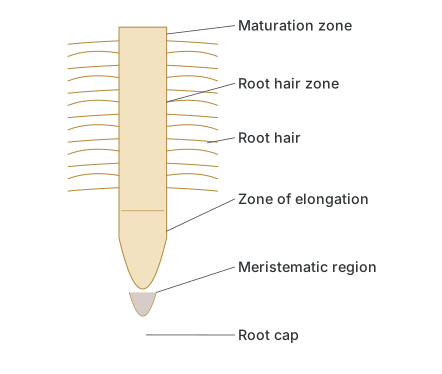
A typical root, seen in longitudinal section, is not uniform along its length but is divided into four successive zones running back from the tip: the root cap (a protective cap of cells at the very apex), the meristematic region (a zone of actively dividing cells just behind the cap), the zone of elongation (where newly formed cells lengthen and drive the root forward through the soil), and finally the root-hair or maturation zone. It is only in this last zone, well behind the growing tip, that the epidermal cells of the root — called epiblema cells — mature and grow out into fine, tubular, unicellular extensions called root hairs.
Drawn by us to help you understand the concept clearly, and verified to make sure it's accurate. For exams, practice from your textbook's own diagram.
What this figure shows. This figure is a longitudinal diagram of a young root tip, dividing it into its four classical zones from the tip upward: the protective root cap at the very apex, the actively dividing meristematic region just behind it, the zone of elongation where cells lengthen and push the root through the soil, and finally the root-hair (maturation) zone, where mature epidermal cells have grown out into fine hair-like extensions. The drawing labels each zone in sequence so a student can see that root hairs form only in the older, non-elongating part of the root, well behind the growing tip, and that this is …
Drawn by us to help you understand the concept clearly, and verified to make sure it's accurate. For exams, practice from your textbook's own diagram.
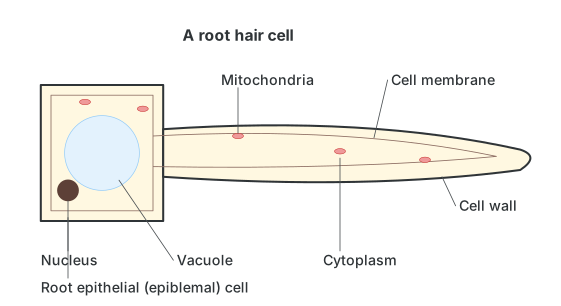
What this figure shows. This is a close-up cutaway diagram of a single root hair, showing it as a long tube-like outgrowth of an epiblema (root epidermal) cell. The drawing labels the two-layered cell wall (an outer pectin-rich layer and an inner cellulose layer), the thin peripheral cytoplasm containing mitochondria, the selectively permeable cell membrane lining the cytoplasm, the large central vacuole that occupies most of the cell's volume, and the nucleus. It visually reinforces that the root hair is delicate, unbranched and short-lived, and that its wall (freely permeable) and membra …
…