Physics · Ch 12 — Electromagnetic Induction
Motion of a Magnet Toward a Loop
Motion of a Magnet Toward a Loop
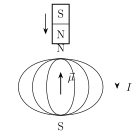
Consider the north pole of a bar magnet approaching a stationary conducting loop. As the magnet nears the loop, the flux linked with the loop (in the direction leading away from the magnet's north pole) increases. By Lenz's law, the induced current must oppose this increasing flux, so it flows in the sense that makes the loop's face nearest the magnet behave like a north pole -- since like poles repel, this loop-face repels the approaching magnet, opposing the very motion that is inducing the current. The right-hand curled-fingers rule for a current loop's equivalent magnetic dipole then fixes the actual sense of circulation of the induced current (counter-clockwise as seen from the approaching magnet, in the standard figure). …
Drawn by us to help you understand the concept clearly, and verified to make sure it's accurate. For exams, practice from your textbook's own diagram.
What this figure shows. Shows the north pole of a bar magnet moving toward a stationary conducting loop, drawn coaxially with it. Inside the loop, curved arrows trace the sense of the induced current flowing around the loop's circumference (counter-clockwise as viewed from the approaching magnet's side, per the accompanying text), and the loop is labelled to show it thereby behaves as an equivalent magnetic dipole with its OWN north pole facing the approaching magnet's north pole -- so the two like poles repel each other, opposing the magnet's approach exactly as Lenz's law requires. No numeric field or current values are shown; the figure exists purely to fix the direction convention linking an approaching magnet's motion to the induc …