Physics · Ch 8 — Electrostatics
Electric Field Intensity due to an Infinitely Long Straight Charged Wire
Electric Field Intensity due to an Infinitely Long Straight Charged Wire
Consider an infinitely long, thin, uniformly charged straight wire (idealised as a line), carrying a constant linear charge density (charge per unit length, units C/m), immersed in a medium of permittivity .
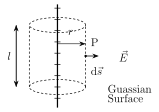
To find the field at a point P a perpendicular distance from the wire's axis, imagine a coaxial Gaussian CYLINDER of radius and some convenient finite length , capped at both ends by flat circular discs perpendicular to the wire. By the cylindrical symmetry of an infinite line charge, has the identical magnitude at every point on the cylinder's curved side surface, and points exactly radially outward there -- parallel to that surface's own normal (). On the two flat end caps, by contrast, is directed purely radially (perpendicular to the wire's axis), which makes it exactly TANGENTIAL to those flat caps (whose own normal runs ALONG the axis) -- so there and the end caps contribute zero flux no matter their area.
The total flux is therefore entirely due to the curved surface: (circumference times length). Equating this to , where the enclosed charge on the length of wire inside the cylinder is , gives , and the length cancels from both sides -- confirming that the answer cannot depend on the arbitrary length chosen for the Gaussian cylinder, only on . The result is : notice this falls off as , NOT -- a slower fall-off than a point charge's field, because the source charge here is spread along an entire infinite line rather than concentrated at one point, so at large distances there is always "more wire" contributing than a single point charge ever could. …
Drawn by us to help you understand the concept clearly, and verified to make sure it's accurate. For exams, practice from your textbook's own diagram.
What this figure shows. An infinitely long, uniformly charged straight wire (linear charge density ) drawn along a central axis, surrounded by a coaxial cylindrical Gaussian surface of radius and finite length , capped at both ends by flat circular discs perpendicular to the wire. A field point P sits on the cylinder's curved surface at perpendicular distance from the wire, with the field vector drawn radiating straight outward from the axis through P, illustrating that is everywhere parallel to the curved surface's outward normal (so it contributes fully to the flux there) while being tangential to -- and hence contributing nothing through -- the two …
Drawn by us to help you understand the concept clearly, and verified to make sure it's accurate. For exams, practice from your textbook's own diagram.
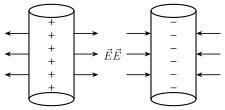
What this figure shows. Two side-by-side sketches of the same coaxial-cylinder construction around a charged wire: in one, the wire's linear charge density is POSITIVE, and field arrows are drawn pointing radially OUTWARD from the wire at several points around the curved Gaussian surface; in the other, is NEGATIVE, and the field arrows point radially INWARD, toward the wire, at the corresponding points. The figure is the direct pictorial companion to the sign convention stated in the text: outward for a positively charged wire, inward for a negatively charged one, exactly mirroring how a point charge's …
Worked out. A straight wire of length m carries a uniform positive charge C. (i) Linear charge density . (ii) Treating the wire as effectively infinite for a nearby field point at m from its centre, , directed radially outward since the wire's char …