Physics · Ch 8 — Electrostatics
Electric Field Intensity due to Uniformly Charged Spherical Shell or Hollow Sphere
Electric Field Intensity due to Uniformly Charged Spherical Shell or Hollow Sphere
Consider a hollow spherical shell of radius , centred at O, carrying charge spread uniformly over its surface with surface charge density (units C/m), so the total charge on the shell is . The shell sits inside a medium of permittivity (with for air or vacuum).
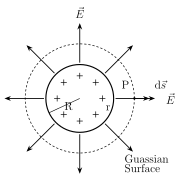
To find the field at a point P a distance from the centre, imagine a concentric Gaussian sphere of radius passing through P. By the spherical symmetry of the source charge, the field has exactly the same magnitude at every point on this Gaussian sphere, and it always points radially -- which means it is everywhere exactly PARALLEL to the Gaussian sphere's own outward area-normal, so at every point and the flux integral collapses from a genuine surface integral into simple multiplication: .
Equating this to from Gauss' law gives , so for any point OUTSIDE the shell (). This is exactly the formula for a POINT charge sitting at O -- so, seen from outside, a uniformly charged sphere is indistinguishable from a point charge of the same total magnitude concentrated at its centre; substituting gives the equivalent form . …
Drawn by us to help you understand the concept clearly, and verified to make sure it's accurate. For exams, practice from your textbook's own diagram.
What this figure shows. A hollow spherical shell of radius centred at point O, its surface uniformly covered with charge (surface charge density , total charge ), shown embedded in a dielectric medium of permittivity . A point P lies outside the shell at distance from the centre O, and a concentric imaginary (Gaussian) sphere of radius is drawn passing through P -- this larger dashed sphere is the Gaussian surface used to apply Gauss' theorem, with the outward radial field vector drawn at P, parallel everywhere to the Gaussian sphere's own outward normal, which is the geometric fact that lets the flux integral …
Worked out. A sphere of radius cm carries charge C. Using for points outside the sphere: (i) at cm m, N/C; (ii) ON the surface, m, N/C (the maximum field this charge can ever produce, since inside the sphere it drops to zero); (iii) at cm, which is INSIDE the sphere (), the field is regardless of how much charge sits on the shell, because the Gaussian sphere at that radius encloses no charge at all -- the worked example is chosen precisely to contrast the …