Physics · Ch 4 — Thermodynamics
Adiabatic Process
Adiabatic Process
An adiabatic process is one in which there is absolutely no transfer of heat between the system and its environment: throughout. This can be achieved in two ways — either by perfectly insulating the system from its surroundings, or by carrying out the change so rapidly that there simply isn't time for any heat to be exchanged, even without deliberate insulation. Puncturing an inflated balloon or tyre is a familiar (rapid, uninsulated) example of an adiabatic change.
First Law for an adiabatic process. With , the First Law reduces to:
When a system expands adiabatically, it does positive work (), so is negative — the internal energy, and hence the temperature, decreases: adiabatic expansion always cools a gas. When a system is compressed adiabatically, work is done ON it ( from the system's perspective), so is positive — the internal energy and temperature increase: adiabatic compression always heats a gas. This is precisely the principle used to ignite fuel in a diesel engine: the fuel-air mixture is compressed so rapidly and so much that it heats to its ignition temperature purely from adiabatic compression, with no spark plug needed at all.
Equation of state. For an adiabatic process:
where is called the adiabatic ratio (or the ratio of specific heats). For moderate temperature changes, for monatomic gases, for diatomic gases, and for triatomic gases — these values follow directly from the degrees-of-freedom counting used in the Class XI kinetic theory chapter to calculate and for each type of gas. Since , this relation lets you find the final pressure once the initial and final volumes (and initial pressure) are known.
Change in internal energy and work done. As always,
and, working through the integral using Eq. (4.16) to substitute for in terms of , the work done in an adiabatic change comes out to:
Since always, this also shows directly (via the ideal gas equation) that when work is done BY an expanding gas (), the final temperature must be lower than the initial one () — the gas cools; and when work is done ON a compressed gas (), the final temperature must be higher () — the gas warms — matching the qualitative conclusion already reached from Eq. (4.15). …
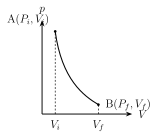
Drawn by us to help you understand the concept clearly, and verified to make sure it's accurate. For exams, practice from your textbook's own diagram.
What this p-V diagram shows. The graph plots pressure p (vertical axis) against volume V (horizontal axis); the area under the curve equals the work done during the process, and the shape of the path tells you how pressure and volume change tog …