Physics · Ch 4 — Thermodynamics
Isothermal Process
Isothermal Process
An isothermal process is one in which a system's pressure and volume change while its temperature is held exactly constant, so . This requires the system to stay in very good thermal contact with an environment at essentially fixed temperature, and for any heat transfer to happen extremely slowly, so that thermal equilibrium (Section 4.2) is maintained at every instant throughout the change. Melting ice at its constant melting point is a familiar physical example of an isothermal process.
Equation of state. Since the temperature is fixed, the ideal gas equation reduces to Boyle's Law:
so for the initial and final states of an isothermal change, .
Work done. Starting from the infinitesimal work (Eq. 4.1) and substituting from the ideal gas equation (with constant, so it can be pulled outside the integral):
Heat exchanged. Because the internal energy of an ideal gas depends only on its temperature (Section 4.4.1), and the temperature is unchanged in an isothermal process, throughout. Applying the First Law, , with :
So for an isothermal process, : all the heat absorbed by the gas is converted completely into the work it does in expanding (and, on compression, all the work done on the gas is released completely as heat). Note that although , neither individually needs to be zero — for an isothermal process, none of and is zero (only is), and consequently the total internal energy content of the system does not stay 'constant' in any deeper sense — heat is continuously exchanged with the environment even while itself does not change. …
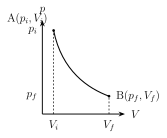
Drawn by us to help you understand the concept clearly, and verified to make sure it's accurate. For exams, practice from your textbook's own diagram.
What this p-V diagram shows. The graph plots pressure p (vertical axis) against volume V (horizontal axis); the area under the curve equals the work done during the process, and the shape of the path tells you how pressure and volume change tog …